


ceat-speciality:blogs-tags/all,ceat-speciality:blogs-tags/tyre-advice
3 Key Rules to Boost Harvester Tyre Load Capacity by 70%
Tue, 25 Nov 2025 | PRODUCTS


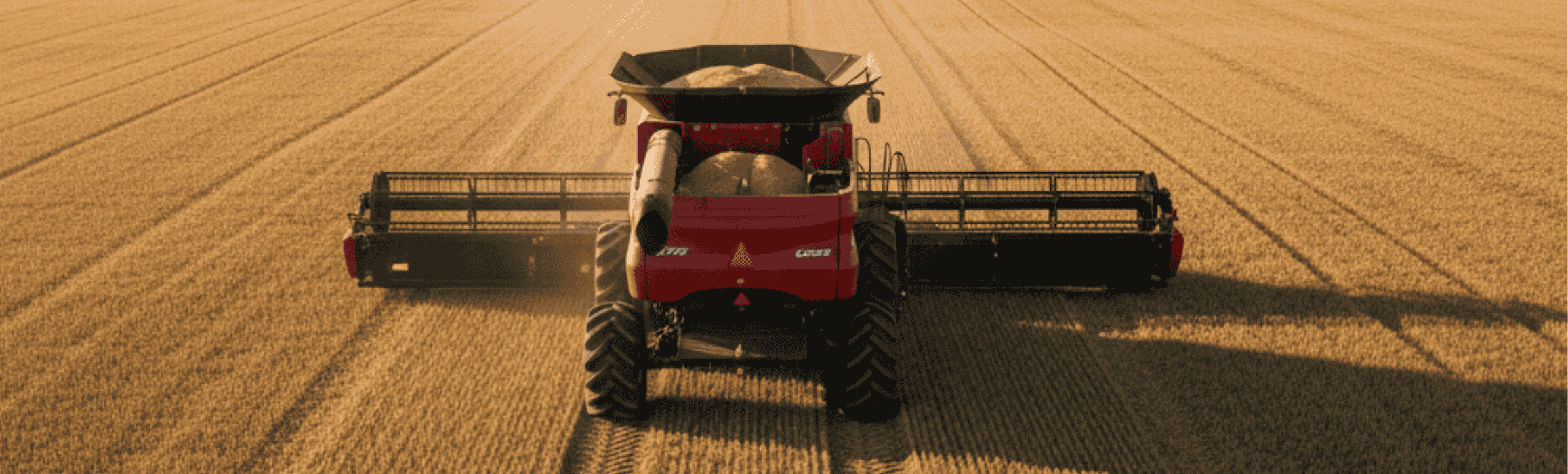
Harvesting season is all about timing, efficiency, and reliability. But if your harvester tyres aren’t built for the job, you’ll hit load limits fast. This leads to frequent unloading, wasted time, and unnecessary wear. The good news? With the right harvester tyres and a few smart adjustments, you can increase your load capacity by up to 70% and keep your operations running smoothly.
Why Standard Harvester Tyres Fall Short
Most harvesters come fitted with standard tyres that simply aren’t designed for heavy, cyclic loads. When the hopper fills up, the pressure on the tyres spikes—especially on the front axle, which carries about 75% of the total weight. This often means:
- Frequent unloading to avoid tyre damage
- Delays when trailer rotations aren’t perfectly timed
- Risk of tyre failure under excess pressure
The CEAT Specialty Solution
CEAT Specialty’s YIELDMAX VFLEX harvester tyres are engineered to handle heavier loads with ease. These reinforced tyres offer:
- Up to 14 tonnes more capacity on the front axle
- 70% more cyclic load tolerance
- Structural strength for fluctuating hopper weights
But to unlock this bonus load safely, you must follow three key rules.
Rule 1: Reduce Speed
Speed and load are a trade-off. The faster you go, the less weight your tyres can safely carry. At 10 km/h and 4 bar pressure, CEAT Specialty YIELDMAX VFLEX tyres can handle 14,025 kg. But at 40 km/h and 3.2 bar, that drops to 8,250 kg.
Why it matters:
Tyres need time to regain their shape between rotations. Excess speed causes deformation, which can lead to casing failure.
Rule 2: Avoid Slopes Over 20%
Steep slopes put uneven pressure on your tyres—especially the ones on the lower side. Anything over 11° (or 20% gradient) increases the risk of:
- Tyre deformation
- Sidewall stress
- Tyres coming off the rim
Stick to flatter terrain when operating under maximum load.
Rule 3: Limit Travel Distance
Bonus load isn’t meant for long hauls. CEAT Specialty recommends no more than 1.5 km under full hopper weight. This protects the tyre’s internal structure and ensures long-term durability.
Why? Hopper weights can fluctuate by up to 12,000 kg, and tyres absorb all that variation. Short distances help manage the strain.
Conclusion: Harvest More, Stress Less
By switching to CEAT Specialty’s reinforced harvester tyres and following these three rules—reduce speed, avoid steep slopes, and limit travel distance—you can safely boost your load capacity by:
- +70% at ≤10 km/h
- +55% at ≤15 km/h
That means fewer unloading stops, faster field coverage, and longer tyre life.


