


ceat-speciality:blogs-tags/all,ceat-speciality:blogs-tags/construction-&-industrial
Solid Resilient vs Solid Press-On Forklift Tyres: What's the Difference and Which Do You Need?
Fri, 25 Sep 2026 | PRODUCTS


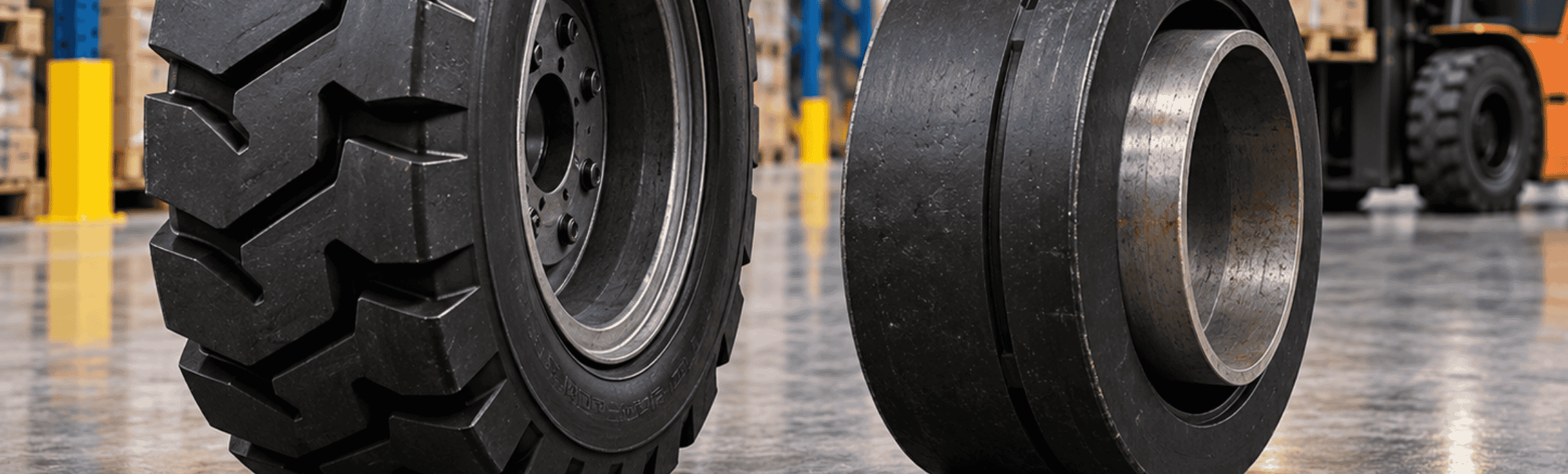
Table of Contents
About CEAT Specialty Tyres
CEAT Specialty tyres houses a team of industry professionals dedicated to publishing accurate, well-researched and practical content on agricultural and OTR tyres. Our editorial team reviews every article for accuracy, clarity and relevance, using trusted sources and current industry best practices.
Solid resilient tyres mount on standard industrial rims using a multi-layer rubber construction, while solid press-on tyres are rubber bands bonded and press-fitted onto a steel wheel band. The core difference comes down to how each tyre attaches to the wheel and the ride characteristics that result from it: resilient tyres flex more for comfort, press-on tyres prioritise stability and load capacity in a compact footprint.
Both are puncture-proof, maintenance-free alternatives to pneumatic forklift tyres, engineered for uptime in warehouses, ports and industrial yards. CEAT Specialty's LiftPro-S range covers both technologies, so the right choice depends on your truck type, floor surface and duty cycle rather than one tyre being universally "better."
This guide breaks down the construction, fitment and application differences so forklift operators and tyre dealers can match the correct tyre to the truck the first time.
Choose solid resilient (SR) tyres for counterbalanced forklifts needing operator comfort and rim-based mounting; choose solid press-on (PN) tyres for compact, high-stability applications like baggage tugs and boarding bridges where a steel-band wheel assembly is preferred.
- Solid Resilient (SR): Multi-layer rubber directly mounted on industrial rims; interchangeable with pneumatic rims in many cases
- Solid Press-On (PN): Rubber tyre bonded to a steel band, press-fitted onto a steel hub
- SR advantage: Better shock absorption and operator comfort via controlled elasticity
- PN advantage: Maximum stability and load-carrying capacity in a compact assembly
- Both: Puncture-proof, zero air pressure maintenance, longer service life than pneumatic tyres
What Is a Solid Resilient Forklift tyre?
A solid resilient tyre is a multi-layer rubber tyre mounted directly onto a standard industrial rim, often interchangeable with pneumatic tyre rims.
The layered construction gives the tyre controlled elasticity. This absorbs shocks, stabilises the load and improves ride comfort, which matters most on forklifts running long shifts on smooth or semi-rough indoor floors.
Key traits of solid resilient (SR) tyres:
- Mounted on standard rims (normal heel or lip heel fitment)
- Multi-layer rubber construction absorbs vibration
- Balances comfort and stability without sacrificing load handling
- Available in black (standard) and non-marking compounds
Solid Resilient Forklift tyres Advantages
- Operator comfort: Layered rubber reduces vibration transfer during long shifts
- Rim compatibility: Often swaps onto existing pneumatic-style rims
- Load stability: Controlled elasticity keeps loads steady during lift and travel
- Reduced maintenance: No inflation, no pressure checks, fewer fleet interruptions
What Is a Solid Press-On Forklift tyre?
A solid press-on tyre is a heavy-duty rubber tyre bonded to a steel band, which is then press-fitted onto a steel wheel hub.
This creates a compact, single-unit wheel-and-tyre assembly rather than a tyre mounted on a separate rim. The steel-band bond maximises stability and load-carrying capacity in a smaller footprint; ideal where space and durability outweigh ride comfort.
Key traits of solid press-on (PN) tyres:
- Rubber bonded directly to a steel band (no separate rim needed)
- Press-fitted onto the steel wheel hub for a compact assembly
- Built for maximum load capacity and stability
- Common on smooth (SM) and traction (TR) tread patterns
Press-On Band Forklift tyres: Where They're Used
- Baggage and cargo trailers/dollies
- Passenger boarding bridges
- Forklift (medium/high intensity)
- Applications needing a compact, low-maintenance wheel unit
Solid Resilient vs Press-On: CEAT Specialty’s Side-by-Side Comparison
| Feature | Solid Resilient (SR) | Solid Press-On (PN) |
Mounting | Direct-mounted on industrial rims | Bonded to steel band, press-fitted on hub |
Construction | Multi-layer rubber | Single rubber band on steel core |
Ride comfort | Higher (absorbs shocks) | Lower (prioritises rigidity) |
Load stability | Strong | Maximum |
Typical use | Counterbalanced forklifts, towing tractors | Baggage carts, boarding bridges, compact trucks |
Rim replacement | Interchangeable with pneumatic rims (often) | Requires steel-band wheel assembly |
Which CEAT Specialty LiftPro-S tyre Fits Your Application?
Match your equipment type first — this determines the forklift tyre technology, not just the size.
| Tyre Category | Pattern / Model | Operational Intensity | Tread / Construction Features | Key Benefits & Performance Profile |
Solid Resilient | SR TR3 | Medium / High Intensity | Advanced 3-layer construction | Premium driver comfort, high durability, engineered for demanding, multi-shift duty cycles. |
Solid Resilient | SR TR2 | Low Intensity | 2-layer standard construction | Cost-effective entry model designed for light, intermittent service (up to 2.5 km/h). |
Solid Resilient | SR SM | Medium / High Intensity | Smooth tread pattern | Maximises floor contact area for superior grip, stability, and wear resistance on clean floors. |
Solid Resilient | SR RIB | Medium / High Intensity | Ribbed directional tread | Enhanced lateral stability, precise cornering control, and a smooth, comfortable ride. |
Solid Press-On | PN SM | Medium / High Intensity | Smooth tread band | Large contact patch providing low rolling resistance and high load-bearing capacity on flat indoor surfaces. |
Solid Press-On | PN TR | Medium / High Intensity | Aggressive traction tread with extra-deep lugs | Superior drive traction and grip on uneven, slippery, or debris-littered operating surfaces. |
Ready to Invest in the Right Tyre for Your Fleet?
Whether you run counterbalanced forklifts, towing tractors or ground support equipment, matching the correct CEAT Specialty LiftPro-S solid resilient or press-on tyre to your rim size and load requirement protects uptime and reduces total cost of ownership. Visit CEAT Specialty tyre’s official website with your tyre size and application details to get the exact fitment and load chart for your fleet.


.png)


