


ceat-speciality:blogs-tags/all,ceat-speciality:blogs-tags/construction-&-industrial
Maximising Telehandler Stability: The Critical Role of Tyre Sidewall Deflection under Load
Wed, 12 Aug 2026 | PRODUCTS


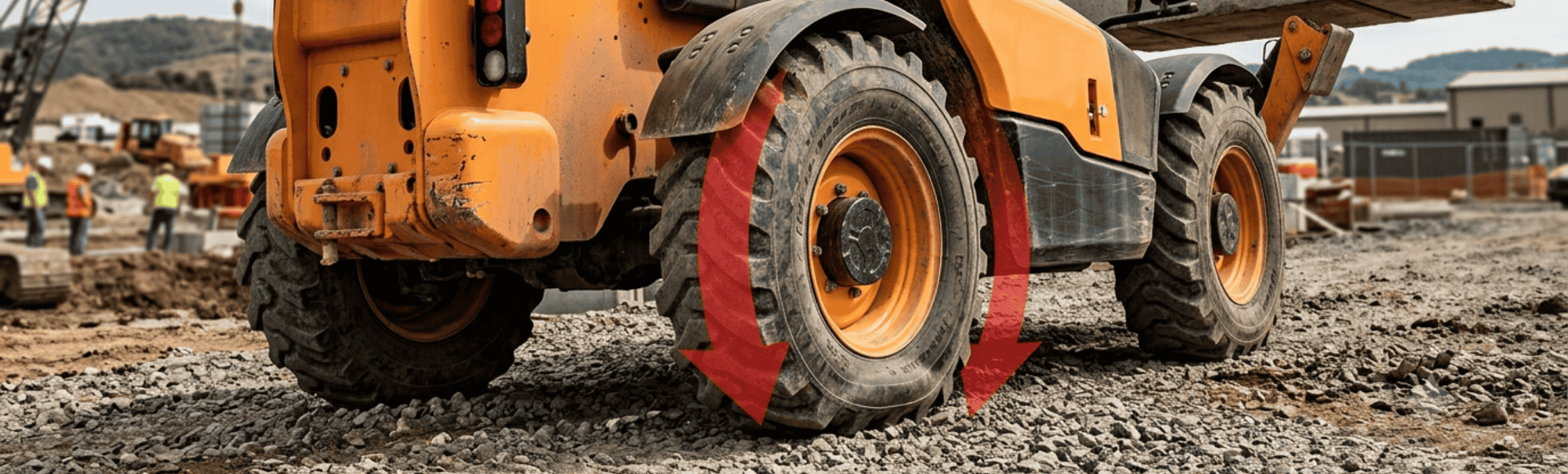
Telehandler stability depends heavily on the performance and structural integrity of its tyres, especially when handling heavy loads at full height extension. Excessive tyre sidewall deflection compromises the machine's balance, raising the risk of tipping, load loss, and catastrophic site accidents. Ensuring optimal lateral stiffness under intense vertical load is vital for maintaining machine equilibrium on uneven job sites.
Using high-quality heavy-duty equipment tyres, such as CEAT Specialty tyres, explicitly addresses this hazard. These tyres are engineered with reinforced carcasses and stiff side casing to withstand severe cyclic loading. Prioritising proper construction equipment tyre maintenance preserves this rigid structure, ensuring continuous on-site safety and maximising material handling efficiency.
Tyre sidewall deflection directly impacts telehandler stability by altering the machine's center of gravity during heavy lifting. Minimising this deflection prevents severe lateral swaying and vehicle tipping.
Key Safety Takeaways:
- Reinforced Engineering: Premium choices like CEAT Specialty tyres feature extra-reinforced sidewalls and rigid casing to resist flexing under load.
- Inflation Control: Consistent construction equipment tyre maintenance keeps internal pressures optimal, minimising dangerous side-to-side deflection.
- Load Balance: High lateral stability ensures precise load positioning, even when the boom is fully extended.
- Carcass Integrity: Strong steel-belted radial or advanced heavy-ply bias construction prevents premature tyre fatigue and buckling.
What Is Tyre Sidewall Deflection and How Does It Impact Telehandler Safety?
Tyre sidewall deflection refers to the vertical and lateral bulging or flexing of a tyre’s sidewall when subjected to heavy weight or shifting forces. In heavy lifting applications, this shifting action compromises telehandler tyre safety by narrowing the vehicle's footprint and destabilising its foundation. When a telehandler lifts a load, the weight transfers forward and downward, forcing the front tyres to bear the brunt of the mass.
Deflection Mechanism Definition by CEAT Specialty Tyres:
| Normal Load | Excessive Load / Under-Inflation |
Tire retains designed shape | Sidewalls bulge outward |
Standard footprint dimensions maintained | Footprint becomes wider and distorted |
Uniform load distribution | Uneven load distribution |
Stable CG position | Lateral CG shift |
Predictable handling and stability | Reduced stability and compromised handling |
If the sidewalls flex excessively, the telehandler’s overall center of gravity shifts outside its safe operating zone. This lateral instability is amplified as the boom extends upward, meaning a minor bulge at ground level can cause severe sway or a rollover at maximum height.
Why Choose CEAT Specialty Tyres for Telehandler Stability?
CEAT Specialty tyres are engineered to deliver superior lateral stiffness and heavy load-carrying capacities, neutralising the risks associated with sidewall flexing. Their innovative design optimises the contact patch, maintaining a firm, flat footprint even under high torque and maximum vertical pressure.
The advanced portfolio features tailored solutions built specifically to handle the demanding cyclic operations of industrial and agricultural material handling:
- CEAT Specialty LOADPRO HARD SURFACE RADIAL: Features an advanced steel-belted radial construction with extra-reinforced sidewalls. This delivers superior lateral stability and exceptional carcass strength, allowing easy and precise loading at height.
- CEAT Specialty LIFTPRO BIAS: Built with a strong nylon casing and thick sidewalls, these tyres offer reinforced durability and long service life. Their robust construction also provides superior lateral stability, ensuring improved load handling, operator confidence, and overall telehandler performance.
Radial vs. Bias Telehandler Tyres: A CEAT Specialty Stability Comparison
When evaluating telehandler tyres, stability depends on more than just construction type. While bias tyres rely on robust casing construction and thicker sidewalls for structural strength, modern radial tyres achieve stability through steel-belted designs that enhance load distribution, puncture resistance, and handling performance.
The comparison below highlights the stability-related characteristics of CEAT Specialty's radial and bias telehandler tyre offerings:
| Feature / Metric | LIFTPRO (Bias) | LOADPRO HARD SURFACE (Radial) |
Construction Type | Bias-ply with strong nylon casing | Steel-belted radial construction |
Stability Design | Thick sidewalls and reinforced nylon casing provide higher radial and lateral stability | Steel belt at the crown increases stability while supporting heavy loads |
Sidewall Characteristics | Strong sidewall construction for durability in demanding applications | Extra-reinforced sidewall helps prevent stub penetration |
Puncture Protection | Deep undertread improves puncture resistance | Steel belt and rugged casing enhance puncture resistance |
Load Handling | Robust construction supports telehandler operations under heavy loads | Rugged casing and rigid belt improve load-carrying capability and weight distribution |
Traction Features | R1 tread pattern designed for enhanced traction | Wider tread and sharp shoulders improve grip and increase contact area |
Primary Advantage | High radial and lateral stability with reinforced bias construction | Stability, load-carrying performance, and operator comfort associated with radial construction |
Best Application | Applications requiring strong casing durability and enhanced traction | Industrial yards, hard-surface operations, and high-cycle material handling |
Key Takeaway
Both constructions are engineered for telehandler tyre stability, but they achieve it differently. The LIFTPRO Bias tyre derives its stability from a strong nylon casing, thick sidewalls, and deep undertread construction. The LOADPRO HARD SURFACE Radial tyre utilises a steel-belted radial design, reinforced sidewalls, and a rigid belt package to deliver stability, puncture resistance, and efficient load handling on hard-surface industrial applications.
Essential Construction Equipment Tyre Maintenance Practices for Maximum Stability
To completely minimise tyre sidewall deflection, fleet managers and operators must follow a strict construction equipment tyre maintenance routine. Structural integrity cannot rely on tyre engineering alone; regular preventative care is required to ensure field safety.
1. Maintain Exact Inflation Pressures: Check inflation pressures daily when the tyres are cold. Under-inflation is the leading cause of excessive sidewall bulging and rapid carcass breakdown.
2. Adhere to Specific Load-Speed Schedules: Consult technical data sheets to match cold inflation pressure against the intended machine load and operational speed.
3. Conduct Regular Visual Inspections: Check for cuts, gouges, or punctures along the sidewalls. Any structural compromise reduces the tyre’s lateral load resistance.
4. Clean Rims and Beads Daily: Ensure there is no trapped debris or stones between the tyre bead and the wheel rim, which can cause slow pressure leaks.
5. Monitor Tread Wear Patterns: Uneven tread wear indicates misalignment or incorrect pressure distribution, both of which accelerate unwanted sidewall flexing.


.png)


