


ceat-speciality:blogs-tags/all,ceat-speciality:blogs-tags/agriculture
How Do Agricultural Tyres Reduce Soil Compaction? A Complete Guide for Healthier Soil and Higher Crop Yields
Mon, 17 Aug 2026 | PRODUCTS


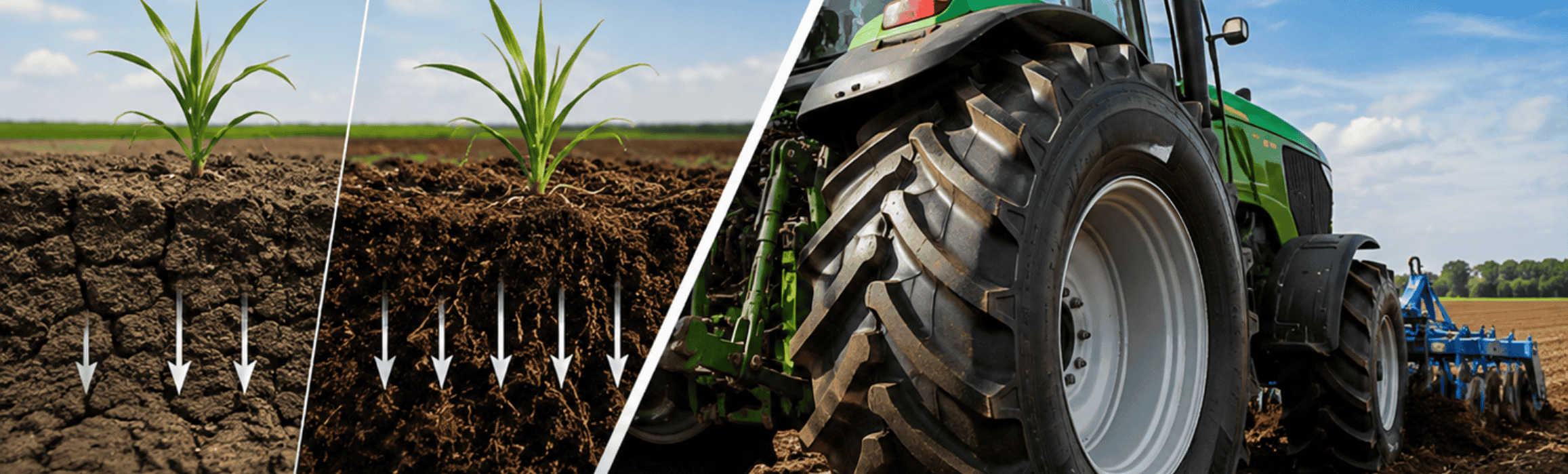
Table of Contents
- About CEAT Specialty Tyres
- Key takeaways for soil compaction management:
- What Is Soil Compaction in Agriculture and Why Is It Harmful?
- How Do Agricultural Tyres Prevent Soil Compaction?
- What Is VF and IF Technology in CEAT Specialty Tyres?
- Premium Solutions: CEAT Specialty Torquemax Tractor Tyre
- Rounding Off: How to Optimise Tyre Usage to Protect Your Soil Step by Step
About CEAT Specialty Tyres
CEAT Specialty tyres houses a team of industry professionals dedicated to publishing accurate, well-researched, and practical content on agricultural and OTR tyres. Our editorial team reviews every article for accuracy, clarity, and relevance, using trusted sources and current industry best practices.
Agricultural tyres reduce soil compaction by distributing heavy machine weight over a larger contact patch, which lowers the Ground Bearing Pressure (GBP) exerted on the soil. Advanced tyre technologies, such as Very High Flexion (VF) and Improved Flexion (IF) designs found in premium CEAT Specialty tyres, allow machinery to run at significantly lower inflation pressures without sacrificing load capacity.
By operating at reduced pressures, these tyres widen the tread footprint, preventing deep soil structural damage and preserving critical pore space for root growth, water infiltration and oxygen movement. Using optimised agricultural tyres soil compaction can be drastically minimised, directly protecting topsoil health and maximising crop yield potential across all farming operations.
Key takeaways for soil compaction management:
- High inflation pressure concentrates machine weight, creating dense, impervious pan layers.
- IF and VF technology allows 20% to 40% lower inflation pressures at equivalent operational loads.
- Larger radial footprints spread axle weight evenly, reducing rut depth and topsoil shear.
- Selecting the right tread pattern, such as CEAT Specialty Torquemax, protects yield potential and improves fuel efficiency.
What Is Soil Compaction in Agriculture and Why Is It Harmful?
Soil compaction occurs when heavy agricultural machinery exerts downward pressure that collapses soil pores, squeezing out air and water essential for healthy plant growth. It creates a dense layer beneath the surface known as a hardpan or plow pan, which restricts root penetration and impedes water drainage.
Soil Compaction is defined as the compression of soil particles into a denser mass, decreasing total porosity, micro-pore continuity and overall soil aeration.
The Impact of Soil Compaction on Farming Operations:
- Restricted Root Development: Crops cannot push roots deep enough to access subsoil moisture and nutrients.
- Poor Drainage & Erosion: Reduced water infiltration leads to standing water, surface runoff and loss of topsoil nutrients.
- Lower Crop Yields: Severely compact soils can reduce overall crop yields significantly.
- Increased Fuel Consumption: Tilling through compacted soil requires greater drawbar pull, burning significantly more fuel.
How Do Agricultural Tyres Prevent Soil Compaction?
Agricultural tyres prevent soil compaction by acting as the primary buffer between heavy machine axles and the ground. The physical key to preventing soil compaction lies in maximising the footprint surface area relative to the load weight.
Mechanisms That Lower Ground Pressure:
1. Low Inflation Pressure Operation: Lower air pressure inside the casing allows the tread face to flatten, increasing the contact area.
2. Radial Casing Construction: Radial belts keep the tread flat across its entire width, unlike bias-ply tyres which bow in the center under heavy loads.
3. Flexible Sidewall Engineering: Advanced casings flex outward under load without collapsing, absorbing shock and distributing weight evenly.
4. Self-Cleaning Lugs: Lugs that clear mud efficiently maintain continuous ground contact, minimising wheel slip and topsoil shearing.
What Is VF and IF Technology in CEAT Specialty Tyres?
Very High Flexion (VF) and Improved Flexion (IF) represent the gold standard in tyre engineering designed to solve how to prevent soil compaction in agriculture. These standards allow tyres to flex significantly more than standard tyres without causing damage to the casing sidewalls.
Comparison Chart Between Standard Agricultural Tyres vs IF/VF CEAT Specialty Agricultural Tyres
| Feature / Standard | Standard Agricultural Tyres | IF (Improved Flexion) | VF (Very High Flexion) |
Load at Standard Pressure | Baseline (100%) | +20% Capacity | +40% Capacity |
Pressure at Standard Load | Baseline (100%) | -20% Reduction | -40% Reduction |
Footprint Size | Standard | Large | Largest |
Soil Compaction Risk | Moderate to High | Low | Lowest |
Premium Solutions: CEAT Specialty Torquemax Tractor Tyre
The CEAT Specialty Torquemax (available in IF/VF variants) is specifically engineered for high-horsepower tractors. Key features include:
- Optimised Lug Design: Steeper lug angles at the center smooth out transport, while wider angles at the shoulder maximise traction and limit soil disturbance.
- Flexible VF Casing: Enables high-capacity operations at lower PSI, spreading heavy tractor weight over a footprint up to 30% wider than traditional radials.
- Enhanced Compound Protection: Prevents stubble damage and wear while operating continuously at low pressures.
Rounding Off: How to Optimise Tyre Usage to Protect Your Soil Step by Step
To get the best soil protection out of your CEAT Specialty tyres, implement these four steps across your operational routine:
1. Calculate Real Axle Loads: Pre-requisite for setting correct inflation pressures.
Weigh individual tractors and implement axles using portable wheel scales or a weighbridge to determine exact load requirements rather than using estimated weight figures.
2. Adjust PSI Based on Application: Match inflation pressure to task and speed.
Set tyre pressures strictly according to the manufacturer's load-speed tables. Reduce PSI to the minimum safe limit for field operations and inflate appropriately when transitioning to prolonged high-speed road transport.
3. Ballast Machinery Correctly: Maintain balanced weight distribution.
Avoid over-ballasting your tractor. Excessive weight increases total axle load and subsoil compaction. Maintain a weight-to-horsepower ratio optimised for your specific field tasks.
4. Monitor Wheel Slip Rates: Prevent soil shearing and topsoil degradation.
Target a wheel slip rate between 8% and 12% approximately in field conditions. Slip rates above 15% shear topsoil particles, destroy soil structure and increase fuel usage.


.png)


