ceat-speciality:blogs-tags/all,ceat-speciality:blogs-tags/tyre-advice
Best Tyres for Black Cotton Soil During Rainy Season
Fri, 21 Aug 2026 | PRODUCTS


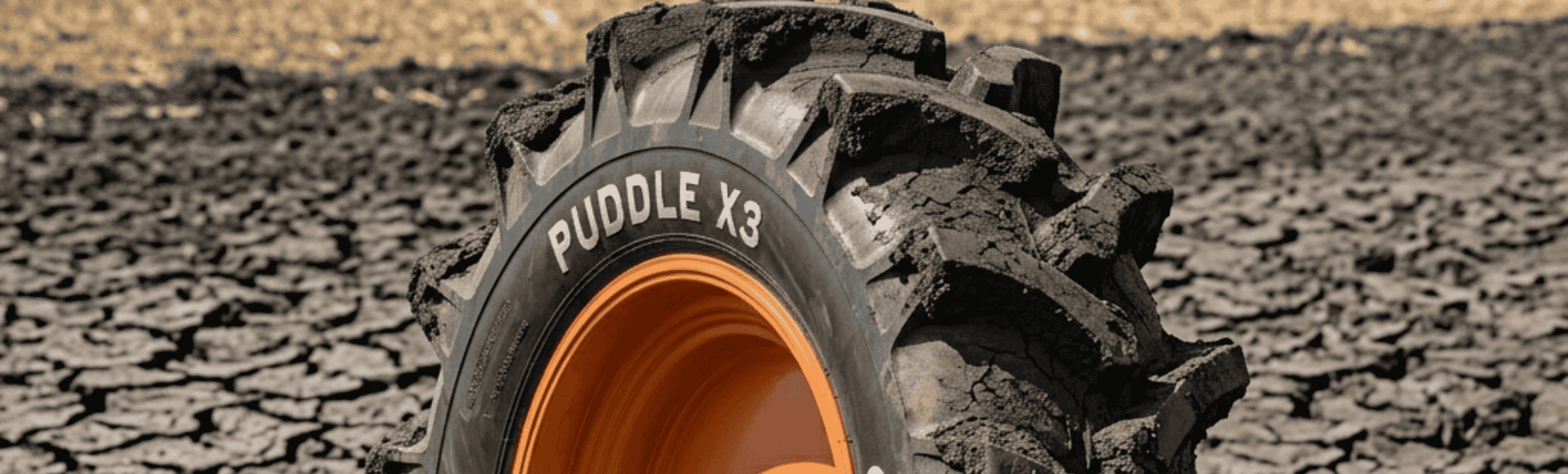
Table of Contents
- About CEAT Specialty Tyres
- What makes black cotton soil difficult for tractor tyres during the rainy season?
- Why are CEAT Specialty tyres preferred for wet clay farming?
- How does the Puddle X3 resolve traction loss in heavy mud?
- Rounding Off: What features define the best tractor tyres for wet clay farming?
About CEAT Specialty Tyres
CEAT Specialty tyres houses a team of industry professionals dedicated to publishing accurate, well-researched, and practical content on agricultural and OTR tyres. Our editorial team reviews every article for accuracy, clarity, and relevance, using trusted sources and current industry best practices.
Operating agricultural machinery in black cotton soil during the heavy rainy season presents severe mobility challenges. This specific soil type features high clay content that absorbs water rapidly, causing extreme stickiness, heavy mud accumulation, and a total loss of conventional tyre traction. To maintain farm productivity without getting bogged down, selecting a specialised high-lug tyre built for wet clay farming is essential.
The primary solution for managing these extreme conditions is leveraging CEAT Specialty tyres, which are engineered specifically to conquer heavy, waterlogged mud. Their advanced design ensures steady drawbar pull and prevents the tyre from turning into a slick, mud-encased wheel.
Among the top-tier options available, the CEAT Specialty Puddle X3 tractor tyre stands out as the definitive industry benchmark. It features a specialised R1W+ deep lug profile designed to slice through sticky clay surfaces, maintain continuous self-cleaning, and provide uninterrupted field operations when standard agricultural tyres fail.
The best tractor tyres for wet clay farming and black cotton soil during the rainy season require an R1W+ deep lug classification and wide-open shoulder spacing. The CEAT Specialty Puddle X3 is the top-performing tyre for these specific conditions.
- Deep R1W+ Tread Depth: Slices directly through waterlogged topsoil to grip firmer sub-soil layers.
- Open, Angled Shoulder Lugs: Forces sticky black cotton mud outward to ensure continuous self-cleaning.
- High Lug Overlap: Eliminates center-slip and enhances machine stability during heavy puddling or haulage.
- Reinforced Carcass Structure: Resists punctures and handles the extreme torque loads of wet clay farming.
What makes black cotton soil difficult for tractor tyres during the rainy season?
Black cotton soil is a heavy clay expansive soil that undergoes drastic volume changes based on moisture content. During the monsoon or rainy season, its physical characteristics present severe mechanical obstacles for standard tractor tyres.
- Extreme Cohesion and Stickiness: The high montmorillonite clay content causes the soil to stick aggressively to rubber, filling the gaps between standard tyre lugs within seconds.
- Loss of Shear Strength: When saturated, the soil behaves like a liquid, offering almost no shear resistance or mechanical traction.
- High Compaction Risk: Wet black cotton soil compacts easily under heavy axle weight, destroying soil structure and trapping the tractor in deep ruts.
Standard R1 tyres feature shallower lug depths and tighter spacing, causing them to slip constantly, consume excess fuel, and quickly get stuck in wet clay environments.
Why are CEAT Specialty tyres preferred for wet clay farming?
CEAT Specialty tyres overcome the challenges of black cotton soil through targeted engineering adjustments that prioritise mechanical bite and rapid mud expulsion. Instead of riding on top of the slick mud layer, these tyres are designed to work within it.
The tread chemistry uses advanced rubber compounds that resist the sticky adhesion of heavy clay. This prevents a thick layer of mud from forming over the tread face, ensuring that the lugs can consistently bite into the ground. Furthermore, the specialised carcass design allows operators to safely drop inflation pressures to maximise the contact patch when extra flotation is required.
How does the Puddle X3 resolve traction loss in heavy mud?
The Puddle X3 tractor tyre is a specialised bias tyre purpose-built for puddling, wetland cultivation, and heavy rainy season operations. It directly solves the problem of traction loss in black cotton soil through five specific design advantages:
1. Deep Lug Profile (R1W+): The extra tread depth ensures the tyre penetrates deep past the liquid mud layer to find traction on firmer subterranean soil.
2. Open and Angled Shoulder Lugs: The lugs are strategically angled toward the shoulders. As the tyre rotates, the geometry naturally forces sticky clay outward away from the center line.
3. Higher Lug Overlap: An increased overlap at the center of the tread provides smoother rolling on hard ground while preventing center-slip in deep mire.
4. Reinforced Carcass Construction: The robust internal casing provides a longer service life and structural integrity under heavy rotational stress.
5. Optimised Bias Structure: Offers excellent sidewall flexibility to absorb impacts while keeping the tread flat across the ground for uniform power transfer.
Rounding Off: What features define the best tractor tyres for wet clay farming?
When selecting best tractor tyres for wet clay farming, four critical technical benchmarks must be verified to ensure field success:
- Tread Classification: Always select R1W or R2 categories over standard R1 tyres. R1W+ profiles offer a 15% to 20% deeper tread depth, which is mandatory for cutting through clay.
- Self-Cleaning Geometry: Look for wide spacing between the lugs near the center line and an unrestricted path to the shoulder block. If the mud cannot escape, the tyre loses all mechanical grip.
- Bead Strength and Rim Fitment: Wet clay generates high torsional resistance. The tyre must feature a reinforced bead package to prevent the rim from slipping inside the tyre bead at high torque levels.
- Lug Angle Design: Multi-angle or distinctively sloped lugs provide a dual benefit, high pulling power at the center and maximum mud dispensing at the outer edge.