ceat-speciality:blogs-tags/all,ceat-speciality:blogs-tags/tyre-advice
How Finite Element Analysis (FEA) Tyre Simulation Pre-Tests Specialty Tyres for Extreme Stress
Fri, 7 Aug 2026 | PRODUCTS


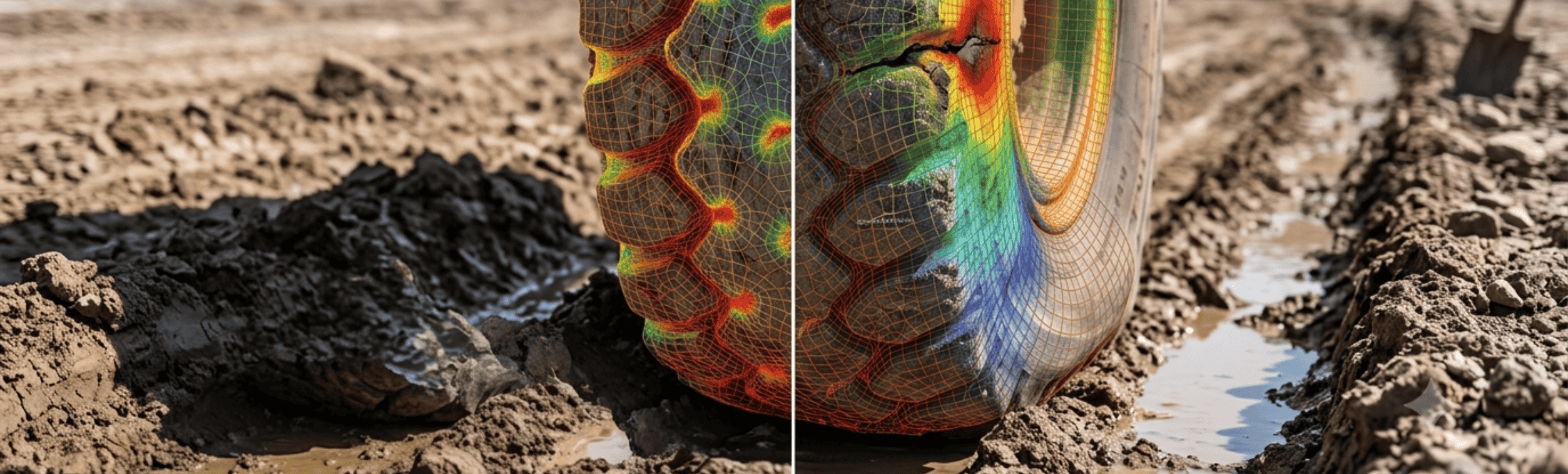
Specialty tyres operating in agriculture, mining, and construction encounter extreme mechanical stress, heavy payloads, and severe terrain conditions. To ensure structural integrity before manufacturing physical prototypes, advanced manufacturers rely on predictive virtual modeling.
Finite Element Analysis (FEA) tyre simulation allows CEAT Specialty tyres to be digitally stress-tested under simulated real-world conditions. This computational method cuts development time, minimises physical prototyping costs, and ensures maximum durability.
By evaluating inflation pressure, footprint contact, and load distribution digitally, engineering teams can predict exact failure points and optimise tread compounds prior to production.
Finite Element Analysis (FEA) tyre simulation pre-tests specialty tyres by dividing a 3D digital model of the tyre into thousands of smaller geometric elements. Computer algorithms apply simulated loads, high inflation pressures, and rough terrain forces to this mesh to analyse stress distribution, deformation and heat generation.
Key Takeaways:
- Predictive Testing: Identifies structural weaknesses and potential bead, carcass, or tread separation before physical manufacturing.
- Footprint Optimisation: Evaluates contact patch pressure to minimise soil compaction in agricultural applications.
- Material Efficiency: Simulates how different rubber compounds and steel belt layouts react to extreme load vectors.
- Enhanced Durability: Validates CEAT Specialty tyres against high inflation pressure and severe shear forces.
What is Finite Element Analysis (FEA) Tyre Simulation?
Finite Element Analysis (FEA) tyre simulation is a computerised methodology used to predict how a specialty tyre reacts to real-world physical forces, heat, vibration, and mechanical stress. The process transforms a complex, continuous 3D tyre CAD model into a finite number of smaller, manageable geometric shapes known as elements, creating a digital mesh.
Core Components of an FEA Tyre Model:
- The Mesh: A network of interconnected nodes that calculate localised stress, displacement, and strain.
- Material Properties: Digital definitions of rubber elasticity, steel cord tensile strength, and fabric ply behaviors.
- Boundary Conditions: Applied constraints mimicking vehicle rim mounting, inflation pressure, and axle load.
By solving complex mathematical equations across this digital mesh, engineers simulate specialty tyre stress testing to observe structural behavior under extreme payloads without building a physical prototype.
How Does FEA Predict Specialty Tyre Stress and Failure?
FEA simulation uses mathematical solvers to expose digital tyre models to virtual punishing environments. This process maps out internal stresses that are impossible to view during traditional physical testing.
Steps in Predictive Tyre Failure Analysis:
1. Geometric Modeling: A precise 3D model of the tyre tread, sidewall, bead, and internal plies is created.
2. Material Mapping: Nonlinear properties of specialised rubber compounds and steel belts used in CEAT Specialty tyres are assigned to the model.
3. Load Application: Virtual forces such as vertical load, lateral cornering forces, torque, and high internal inflation pressures are applied.
4. Stress Mapping: The software highlights high-concentration stress zones using a color-coded visual scale (typically red for high stress, blue for low stress).
| Stress Level | Color Indicator | Operating Condition |
Low Stress | 🟦 Blue | Safe Operating Zone |
Moderate Stress | 🟨 Yellow | Monitored Wear Zone |
High Stress | 🟥 Red | Potential Failure Point |
Through this systematic analysis, engineers perform predictive tyre failure analysis to identify where plies might separate, where the bead might unseat, or where the sidewall could buckle under heavy agricultural or industrial loads.
Why CEAT Specialty Tyres Depend on Advanced Simulation
Heavy-duty applications demand specialised engineering. Agricultural tyres must minimise soil compaction, while mining tyres require extreme puncture resistance. CEAT Specialty tyres leverage FEA simulation to balance these conflicting performance metrics.
Performance Indicators Optimised via FEA:
| Performance Metric | Simulated Condition | Engineering Outcome |
Contact Patch Area | Variable load & low inflation pressure | Maximised footprint to prevent soil compaction |
Bead Zone Integrity | High torque & heavy payloads | Prevention of tyre slip on the rim |
Tread Lug Durability | Rocky terrain shear forces | Reduced chunking and uneven wear patterns |
Carcass Endurance | Cyclic deflection over obstacles | Extended casing life for retreading |
By utilising FEA, CEAT Specialty tyre designs robust internal structures that uniformly distribute stress across the carcass, preventing overheating and premature casing fatigue.
What Are the Main Benefits of Pre-Testing Tyres via FEA?
Transitioning from traditional trial-and-error prototyping to simulation-driven development delivers measurable industrial advantages for off-highway and specialty tyres.
- Accelerated Time-to-Market: Digital simulations run in hours, whereas physical molding, curing, and field testing take months.
- Cost Reduction: Minimises the need for multiple expensive physical molds and destructive testing setups.
- Extreme Scenario Testing: Allows engineers to safely simulate catastrophic overloads, high-speed impacts, and extreme thermal conditions that are dangerous to replicate in physical labs.
- Precision Engineering: Enables micro-adjustments to tread lug angles and belt configurations to maximise traction and fuel efficiency.