


ceat-speciality:blogs-tags/all,ceat-speciality:blogs-tags/tyre-advice
VF vs IF Tractor Tyres: Which Flexion Technology Increases Crop Yields and Reduces Fuel Costs?
Fri, 12 Jun 2026 | PRODUCTS


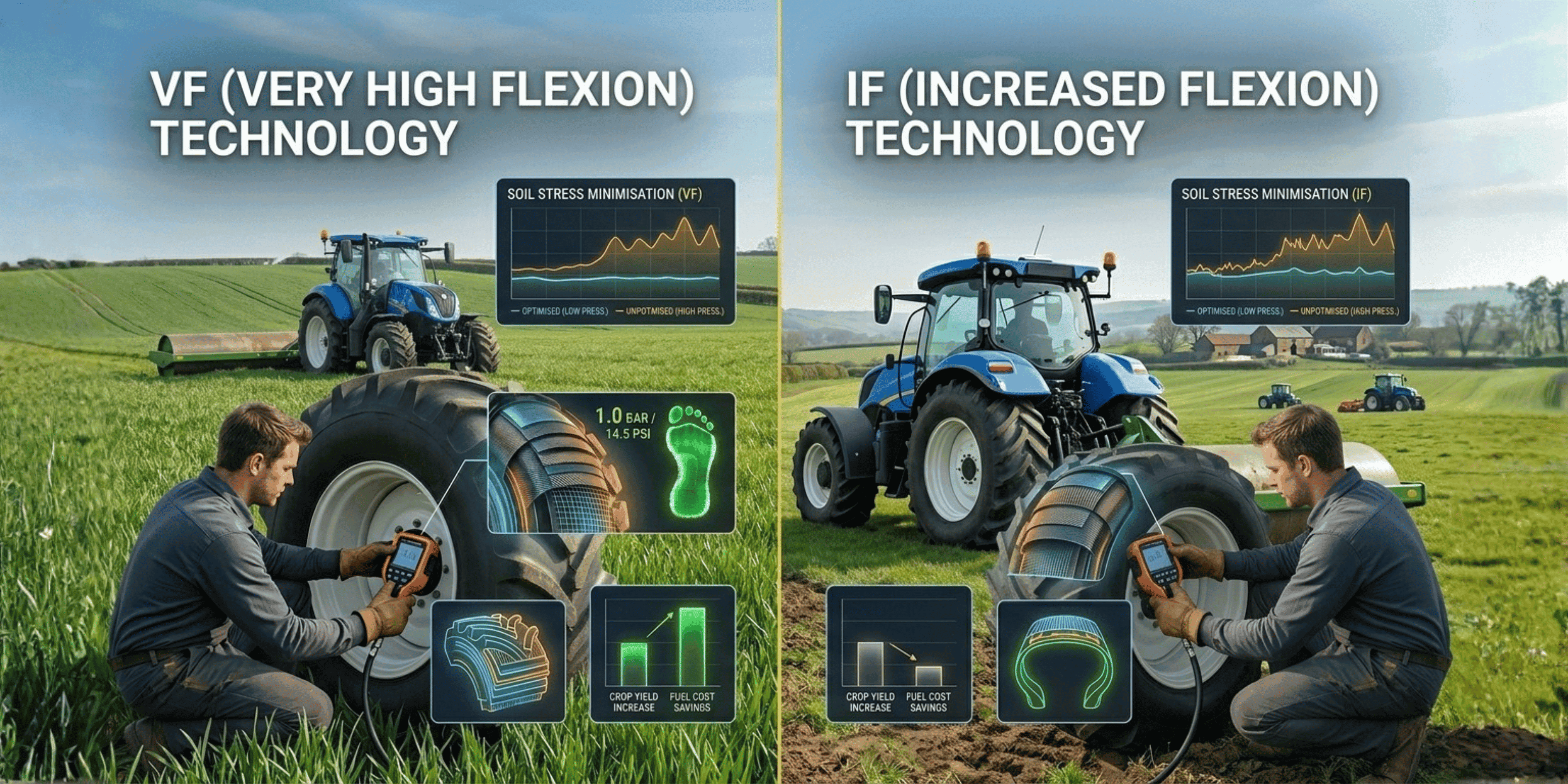
Table of Contents
- What is the Difference Between VF and IF Tractor Tyres?
- VF vs IF Technical Comparison Table
- How Do Low Pressure Tractor Tyres Increase Crop Yields?
- How VF Tyres Protect Your Soil Structure
- Why Do CEAT Specialty Tyres Lower Farm Fuel Costs?
- Fuel Efficiency Benefits of VF Technology
- VF vs IF Tractor Tyres: Which Should You Choose?
- When to Choose VF Tyres (e.g., CEAT Specialty Torquemax VF)
Selecting the right agricultural tyre technology is critical to maximising farm profitability. When comparing VF vs IF tractor tyres, VF (Very High Flexion) technology provides the highest crop yields and lowest fuel costs. VF tyres allow tractors to carry the same load at 40% lower inflation pressure compared to standard radial tyres, significantly outperforming IF (Improved Flexion) tyres, which only allow a 20% pressure reduction.
By operating at lower inflation pressures, VF tyres create a larger footprint. This distributes machine weight evenly, minimises soil compaction, and eliminates wheel slippage to optimise fuel efficiency. For farmers seeking the best tractor tyres to reduce soil compaction, migrating to CEAT Specialty tyres featuring VF technology offers the highest return on investment.
- The Winner: VF (Very High Flexion) tyres outperform IF (Improved Flexion) tyres in both fuel economy and yield preservation.
- Pressure Reduction: VF tyres run at 40% lower pressure than standard radials; IF tyres run at 20% lower pressure.
- Yield Impact: VF technology reduces soil compaction depth, protecting root structures to increase crop yields by up to 3% to 5%.
- Fuel Efficiency: The larger footprint of VF tyres reduces wheel slip, saving up to 10% in fuel consumption during heavy field operations.
What is the Difference Between VF and IF Tractor Tyres?
The core difference between VF (Very High Flexion) and IF (Improved Flexion) agricultural tyre technology lies in their load-carrying capacity and inflation pressure thresholds. Both categories utilise highly flexible sidewalls, but they operate at different efficiency levels.
- IF (Improved Flexion) Tyres: Designed to carry 20% more load than a standard radial tyre at the same inflation pressure, or carry the same load at 20% less pressure.
- VF (Very High Flexion) Tyres: Engineered to carry 40% more load than a standard radial tyre at the same inflation pressure, or carry the same load at 40% less pressure.
VF vs IF Technical Comparison Table
| Feature / Metric | Standard Radial Tyres | IF (Improved Flexion) Tyres | VF (Very High Flexion) Tyres |
Pressure Reduction (at same load) | Baseline (0%) | 20% Lower | 40% Lower |
Load Capacity (at same pressure) | Baseline (0%) | 20% Higher | 40% Higher |
Footprint Size Expansion | Baseline | Moderate (+15-20%) | Maximum (+30-40%) |
Soil Compaction Risk | High | Medium | Low |
Fuel Savings Potential | Baseline | Moderate (3-5%) | High (8-10%) |
How Do Low Pressure Tractor Tyres Increase Crop Yields?
VF tractor tyres directly increase crop yields by eliminating severe soil compaction. When a tractor operates on low pressure tractor tyres, the weight of the machinery is distributed across a wider surface area, preventing the destruction of soil structure.
Heavy machinery operating on over-inflated standard tyres compresses the pore spaces in the soil. This restriction blocks air and water from infiltrating the root zone, stunting root development and lowering overall crop yields.
How VF Tyres Protect Your Soil Structure
1. Enlarged Footprint: VF tyres, like CEAT Specialty Torquemax tractor tyres, create a footprint up to 40% larger than standard radials, distributing tractor weight evenly.
2. Reduced Ground Pressure: Operating at 40% lower PSI prevents the tyre from sinking deeply into the topsoil.
3. Preserved Pore Space: Protecting the soil matrix allows roots to access essential nutrients and moisture.
4. Enhanced Yield Output: Field studies indicate that reducing soil compaction via VF technology can improve crop yields by 3% to 5% compared to standard tyres.
Why Do CEAT Specialty Tyres Lower Farm Fuel Costs?
CEAT Specialty tyres engineered with VF technology reduce fuel costs by maximising traction and eliminating wheel slippage. When a tyre slips in wet or loose soil, energy from the engine is wasted as heat and friction instead of propelling the tractor forward.
Because VF tyres feature an elongated contact patch, more tread lugs engage with the ground simultaneously. This optimal grip converts engine torque directly into forward motion, speeding up field operations and reducing hourly fuel burn.
Fuel Efficiency Benefits of VF Technology
- Reduced Wheel Slip: VF tyres maintain traction, keeping wheel slippage under the ideal 10-15% threshold.
- Lower Rolling Resistance: Running at lower pressures allows the tyre to roll over the soil rather than pushing a dirt wave in front of it.
- Fewer Engine Hours: Improved traction means field tasks like tilling and planting are completed faster, reducing overall engine run time.
- Direct Cost Savings: Transitioning from standard radials to VF tyres can reduce overall fuel consumption by up to 10% during heavy draft work.
VF vs IF Tractor Tyres: Which Should You Choose?
Choosing between VF and IF technology depends on your equipment weight, operating conditions, and budget. VF tyres represent the pinnacle of agricultural tyre technology and deliver the highest operational savings, making them ideal for heavy high-horsepower tractors, self-propelled sprayers, and combine harvesters.
For maximum fuel economy and yield protection, VF tyres offer superior long-term financial returns.
When to Choose VF Tyres (e.g., CEAT Specialty Torquemax VF)
- For high-horsepower tractors (200+ HP) engaged in heavy tillage.
- For heavy harvesting equipment and tankers where axle loads fluctuate wildly.
- When working on moisture-heavy, compaction-prone clay or loam soils.


