


ceat-speciality:blogs-tags/all,ceat-speciality:blogs-tags/tyre-advice
Predictive Maintenance for OTR Tyres: Extending Port & Mining Tyre Life
Tue, 9 Jun 2026 | PRODUCTS


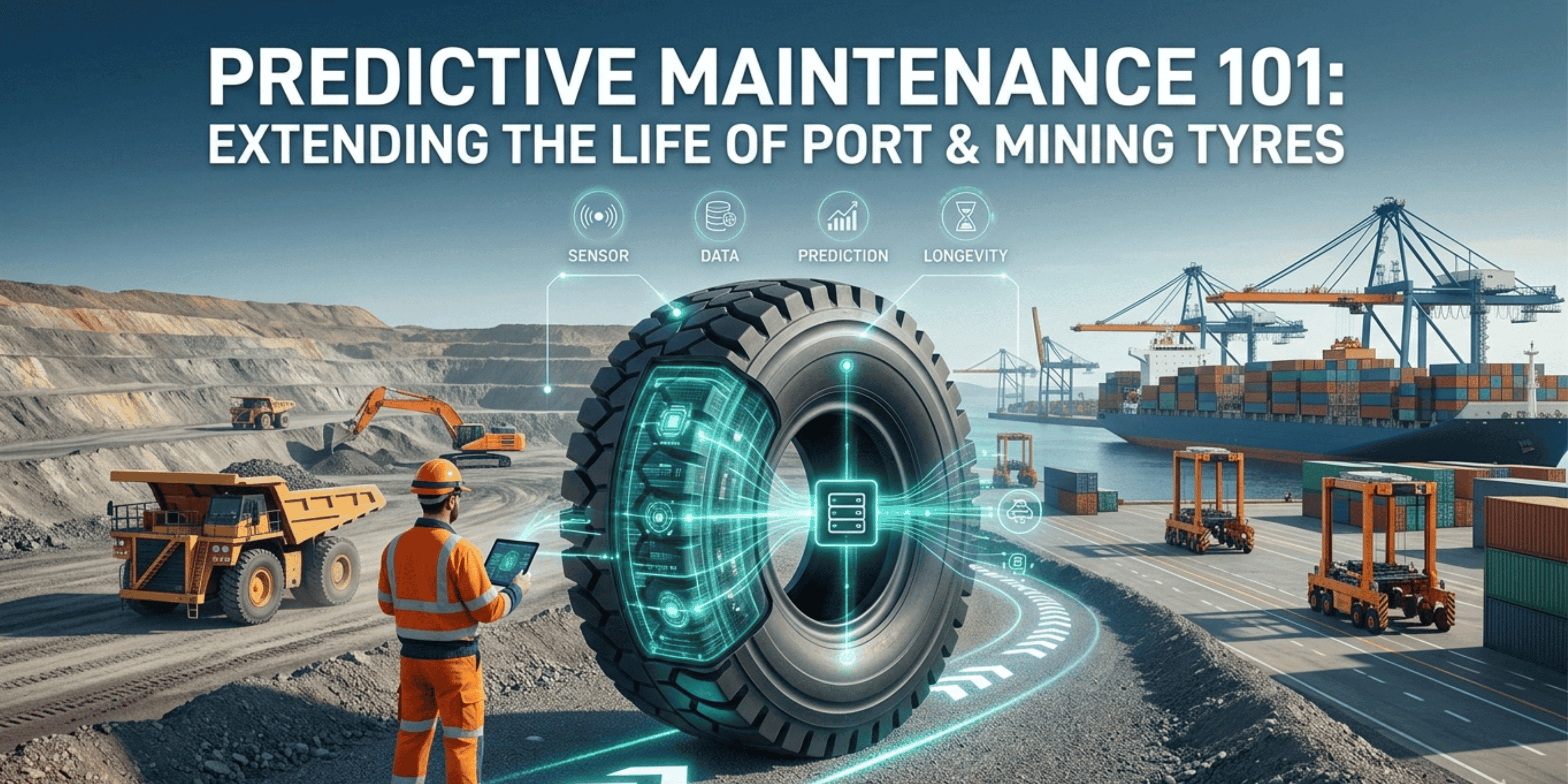
Table of Contents
- Key Takeaways:
- What is Predictive Maintenance for OTR Tyres?
- How Does Predictive Maintenance Reduce Port Crane Tyre Wear?
- Eliminating Common Port Equipment Tyre Maintenance Issues
- Impact of Predictive Maintenance on Port Crane Components
- Why Choose CEAT Specialty Tyres for Heavy OTR Operations?
- Implementing Predictive Maintenance for OTR Tyres in 4 Steps
Predictive maintenance for OTR tyres is a data-driven strategy that uses real-time monitoring to forecast tyre failures before they occur. By continuously tracking metrics like internal temperature, inflation pressure, and tread depth, fleet operators can optimise vehicle uptime and significantly extend operational life.
For high-stress environments utilising CEAT Specialty tyres, implementing a proactive management framework prevents catastrophic blowouts, lowers total cost of ownership (TCO), and ensures structural integrity under extreme payloads.
This guide details how port equipment tyre maintenance and advanced OTR tyre management systems eliminate unpredictable downtime, control heat buildup, and mitigate uneven tread wear.
Predictive maintenance maximises OTR tyre life by using telematics, TPMS sensors, and predictive algorithms to schedule service based on actual tyre condition rather than fixed time intervals.
Key Takeaways:
- Prevents Thermal Degradation: Tracks internal heat signatures to prevent casing separation in mining haulage.
- Reduces Irregular Wear: Corrects pressure deviations instantly to eliminate uneven scrubbing on port surfaces.
- Lowers Operational Costs: Minimises unscheduled downtime and maximises hours-to-removal metrics.
- Optimises Structural Asset Life: Preserves premium casings for potential retreading.
What is Predictive Maintenance for OTR Tyres?
Predictive maintenance for OTR tyres is the practice of collecting real-time operational data from tyre sensors to analyse health trends, predict wear patterns, and schedule targeted maintenance interventions before a failure occurs. This contrasts with reactive maintenance (fixing tyres after failure) and preventative maintenance (replacing tyres based purely on calendar schedules).
Core Components of an OTR Tyre Management System
An effective OTR tyre management system integrates specific hardware and software components to capture actionable data:
- Tyre Pressure Monitoring Systems (TPMS): Valve-stem or patch-mounted TPMS sensors that continuously log pressure and internal temperature.
- Telematics Gateways: On-board data hubs that transmit tyre telemetry to cloud-based monitoring platforms.
- Predictive Analytics Engines: Software algorithms that cross-reference temperature spikes, pressure drops, and ambient conditions to calculate remaining useful life (RUL).
- Digital Tread Depth Gauges: Bluetooth-enabled tools that track physical rubber loss over operating hours to calculate exact wear rates.
How Does Predictive Maintenance Reduce Port Crane Tyre Wear?
Reducing port crane tyre wear with predictive maintenance relies on mitigating the extreme lateral forces and high load cycles typical of container handling equipment. Port cranes, reach stackers, and empty container handlers operate on abrasive concrete surfaces, making them highly susceptible to rapid tread scrubbing and heat buildup.
Eliminating Common Port Equipment Tyre Maintenance Issues
Port equipment tyre maintenance platforms counteract rapid wear by isolating the specific operational variables that accelerate rubber degradation:
1. Micro-Leak Detection: Even a 10% drop in inflation pressure increases sidewall deflection. This deflection accelerates shoulder wear and raises internal temperatures during heavy container lifts.
2. Dual-Tyre Mating Analysis: On twin-tyre configurations, a pressure imbalance forces the inflated tyre to carry a disproportionate load, leading to rapid center-tread wear.
3. Duty Cycle Optimisation: Continuous tracking identifies units experiencing high-speed tracking or prolonged travel distances, allowing operators to rotate equipment before thermal thresholds are exceeded.
Impact of Predictive Maintenance on Port Crane Components
| Maintenance Strategy | Average Tyre Lifespan | Primary Failure Mode< | Risk of Catastrophic Failure |
Reactive | Short (Sub-optimal hours) | Blowouts, severe scrubbing | High |
Scheduled / Preventive | Moderate | Early removal, wasted tread | Medium |
Predictive | Maximum (Optimised hours) | Uniform tread wear | Extremely Low |
Why Choose CEAT Specialty Tyres for Heavy OTR Operations?
Maximising the ROI of a predictive maintenance program requires sourcing high-performance rubber compounds designed to interface seamlessly with modern tracking frameworks. CEAT Specialty tyres are engineered with advanced structural integrity and robust casing designs tailored specifically for tough port and mining applications.
Port Tyres Optimisation
CEAT Specialty port tyres portfolio, including specialised tyres for reach stackers and gantry cranes, features heavy-duty nylon casings and advanced tread compounds. These design choices resist the intense heat generated during frequent, high-load braking and tight-radius turning maneuvers on dockside pavements.
Mining Tyres Resilience
For mining applications, CEAT Specialty mining tyres utilise cut-and-chip resistant compounds coupled with deep tread profiles. When monitored via a digital OTR tyre management system, these tyres provide predictable, linear wear rates. This predictability allows fleet managers to schedule rotations perfectly, preventing rock cuts from developing into structural casing failures.
Implementing Predictive Maintenance for OTR Tyres in 4 Steps
Transitioning to a predictive maintenance model requires a systematic deployment of sensor infrastructure and data workflows.
1. Equip the Fleet with Sensors: Install ruggedised, heat-resistant TPMS sensors inside the chamber or on the valves of all active CEAT Specialty tyres.
2. Establish Baseline Thresholds: Define normal operational parameters for pressure (PSI/bar) and temperature (°C/°F) based on specific machine payloads and ambient site environments.
3. Integrate Real-Time Alert Protocols: Configure the management software to trigger multi-stage alerts (e.g., Caution, Critical) when a tyre deviates from baseline metrics.
4. Execute Data-Driven Interventions: Schedule targeted maintenance actions, such as pressure corrections, wheel alignments, or tyre rotations, during natural operational windows before failure occurs.


