


ceat-speciality:blogs-tags/all,ceat-speciality:blogs-tags/tyre-advice
Radial vs Bias Agricultural Tyres: Which Is Better for Modern Farming?
Mon, 31 Aug 2026 | PRODUCTS


About CEAT Specialty Tyres
CEAT Specialty tyres houses a team of industry professionals dedicated to publishing accurate, well-researched, and practical content on agricultural and OTR tyres. Our editorial team reviews every article for accuracy, clarity, and relevance, using trusted sources and current industry best practices.
Choosing the right tractor tyres is a critical business decision that directly impacts fuel efficiency, soil health, and seasonal yield. With the rise of high-horsepower tractors and heavy implements, selecting between radial and bias tyre constructions has a massive influence on overall operating costs.
While radial tyres have become the standard for primary field operations due to their flexibility and traction, bias-ply tyres remain highly valued for their extreme durability and budget-friendly pricing in specific applications.
By analysing structural design, soil protection and lifetime operating costs, this guide will help you determine the best tyres for farm tractors on your land.
For primary fieldwork and high horsepower tractors, radial tyres are the superior choice because they reduce soil compaction, improve fuel efficiency and offer around 30% longer service life. Bias tyres are best reserved for utility tractors, forestry, yard operations or heavy industrial loading where sidewall puncture resistance is the priority.
- Choose Radial for: High traction, minimal soil compaction, heavy field tillage, and road transit.
- Choose Bias for: Sidewall cut resistance, forestry/shrub clearing, yard loader work, and lower upfront budgets.
- Best Brand Value: CEAT Specialty tyres offer high-performance agricultural tyres in both radial and bias options to fit specific farm demands.
What is the Difference Between Radial and Bias Tractor Tyres?
The fundamental difference between these two categories lies in their internal carcass construction, which dictates how the tread and sidewall interact under pressure.
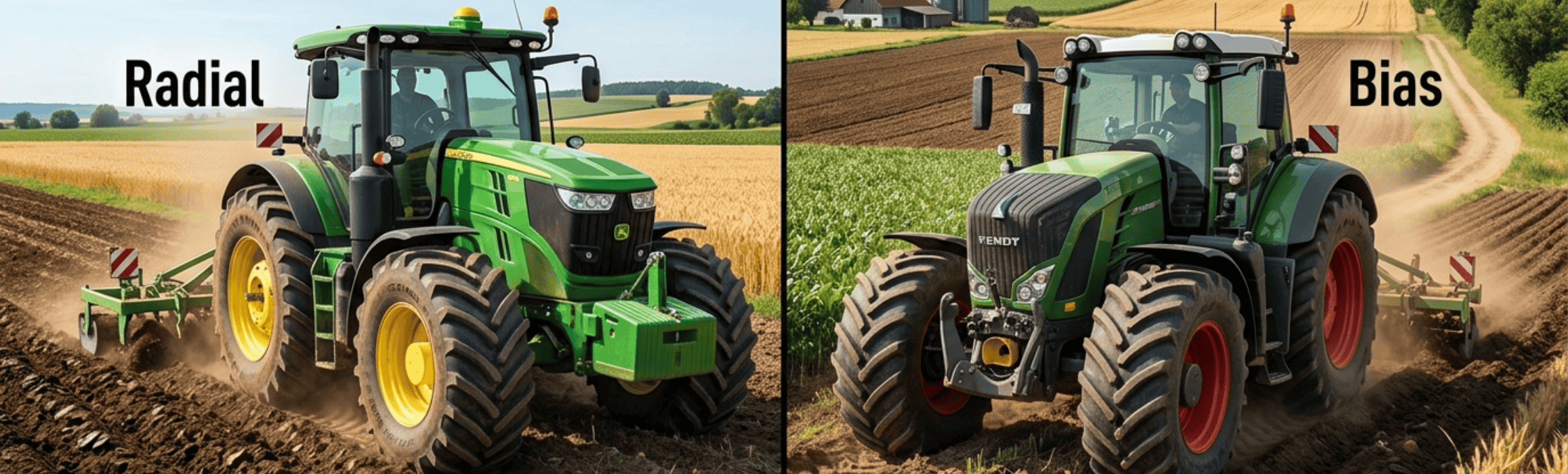
- Radial Tyre Construction: Cords are laid at 90 degrees (perpendicular) to the direction of travel. The sidewall behaves independently of the tread, allowing it to flex while maintaining a flat, uniform contact patch on the ground.
- Bias (Cross-Ply) Tyre Construction: Multiple layers of fabric cords are crossed diagonally from bead to bead. This makes the tread and the sidewalls a single, rigid unit.
How Do Radial and Bias Tyres Compare in Performance?
Evaluating how each agricultural tyre operates under load, on the road and in wet fields helps maximise tractor productivity.
Traction and Slip Rate
Radial tractor tyres provide a larger, wider footprint compared to bias options. This increased ground contact ensures more lugs engage with the soil, reducing wheel slip and saving valuable fuel. Bias tyres, due to their rigid tread, experience bulging at the tyre crown which reduces overall grip in loose soil.
Soil Compaction and Crop Yield
Soil protection is a primary consideration in modern farming.
- Radial: Flexes to distribute weight evenly across a large contact area. This low-ground-pressure performance minimises soil compaction, allowing roots to grow freely.
- Bias: Concentrates vehicle weight into a smaller, stiffer zone. This causes deeper rutting, limits water infiltration and can restrict crop yields.
Roadability and Operator Comfort
Modern farming frequently involves road transit between split plots. The flexible sidewalls of radial tyres absorb shocks and potholes, offering superior operator comfort and less machinery wear. In contrast, bias tyres transfer more vibrations directly to the cabin, leading to a stiffer, noisier ride.
| Performance Attribute | Radial Tyres | Bias Tyres |
Footprint Size | Large and flat | Narrow and rounded |
Traction Level | Excellent (minimal wheel slip) | Moderate (higher slip rates) |
Soil Protection | High (low ground pressure) | Low (concentrated weight) |
Sidewall Stiffness | Flexible (self-cushioning) | Rigid (highly puncture resistant) |
Fuel Efficiency | High (low rolling resistance) | Moderate |
Typical Lifespan | Approximately 30% longer than bias | Base standard lifespan |
When Should Farmers Choose Radial Tyres?
Radial agricultural tyres are the best choice for modern farming operations that demand higher productivity, improved fuel efficiency and reduced soil compaction.
- Extensive Field Operations: For tractors engaged in ploughing, sowing, tillage, and harvesting over large acreages, radial tyres provide a larger contact patch that delivers superior traction while minimising wheel slip.
- Frequent Road Transport: If your tractor regularly travels between fields or transports heavy loads on paved roads, radial tyres offer a smoother ride, lower rolling resistance, and reduced fuel consumption.
- Soil Protection and Crop Health: The flexible sidewalls of radial tyres distribute weight more evenly across the ground, reducing soil compaction and preserving soil structure for better root development and crop yields.
- High-Annual-Hour Tractors: For tractors operating more than 500 hours per year, the longer tread life, improved durability, and lower operating costs of radial tyres provide greater value despite their higher initial investment.
Final Thoughts: What Are the Best Tyres for Farm Tractors from CEAT Specialty?
CEAT Specialty tyres are engineered to deliver reliable performance across both construction types, helping farmers manage total cost of ownership (TCO).
CEAT Specialty Radial Tyres for Fieldwork
- Torquemax: Excellent roadability and traction with reduced vibration and noise, thanks to a tilted lug design, optimised lug angles, rounded shoulders that minimise soil and crop damage, a wider tread with larger inner volume to reduce soil compaction, and an R1-W tread depth for extended tyre life.
- Yieldmax VFLEX: A directional tread pattern ensures a comfortable ride and reduced wear, while the ultra-wide design, large center tread block, IF/VF technology for 20–40% lower inflation pressure and rounded shoulders deliver superior traction, better pressure distribution, reduced soil compaction, and enhanced crop protection.
CEAT Specialty Bias Tyres for Rugged Durability
- Farmax AS: Excellent self-cleaning performance, a robust lug design for high traction and increased grip, a reinforced carcass for enhanced load capacity on medium- to low-powered farm machinery, and a high-denier textile casing with superior tread and sidewall compounds for a long, trouble-free lifespan.
- Trencher XL: Excellent self-cleaning properties, increased grip, superior tread compounds for longer life and resistance to chipping and tearing, and suitability for multipurpose applications.


