


ceat-speciality:blogs-tags/all,ceat-speciality:blogs-tags/tyre-advice
VF Tyres vs Standard Radial Total Cost of Ownership: Agricultural ROI Breakdown
Fri, 7 Aug 2026 | PRODUCTS


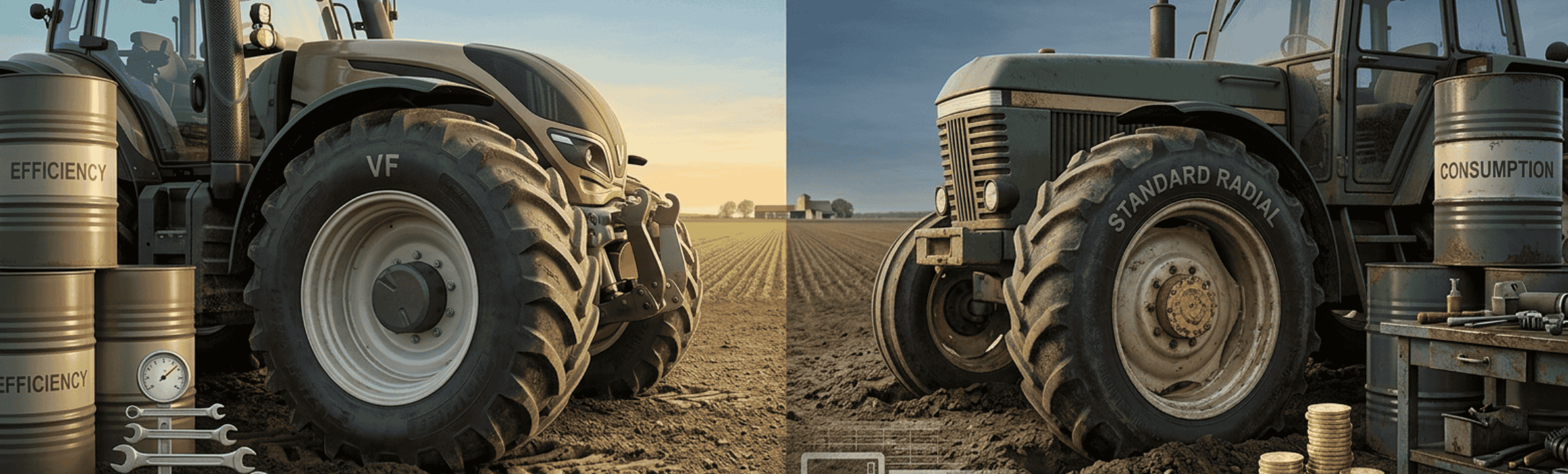
Evaluating the financial impact of agricultural machinery investments requires looking beyond initial purchase price to analyse the Total Cost of Ownership (TCO). For modern, high-horsepower tractors and harvesters, the choice between Very High Flexion (VF) tyres and standard radial tyres serves as a primary driver of long-term operational costs.
Upgrading to premium options like CEAT Specialty tyres engineered with advanced VF technology, VF options achieve a substantially lower TCO across their operational lifespan by generating quantifiable savings in fuel efficiency, crop yield preservation, and tyre longevity.
This comprehensive TCO breakdown demonstrates how utilising an agricultural tyre ROI calculator to factor in soil compaction costs and fuel consumption reveals that VF technology delivers a significantly higher net return on investment (ROI).
The Total Cost of Ownership (TCO) of VF tyres is 12% to 18% lower than standard radial tyres over a 3,000-hour operational lifespan. VF farm and agricultural tyres offset initial cost within the first 12 to 18 months through specific performance advantages:
- 40% lower inflation pressure at identical loads, expanding the footprint to reduce crop-destroying soil compaction.
- Up to 4% reduction in fuel consumption achieved by minimising wheel slip and lowering rolling resistance.
- 3% to 5% increase in seasonal crop yields due to preserved soil structure and improved root development.
- Extended tyre service life resulting from reinforced, highly flexible sidewalls and cut-resistant casing compounds.
What is the difference in very high flexion tyres load capacity comparison?
A direct very high flexion tyres load capacity comparison highlights the engineering differences between VF designs and standard agricultural radials. Standard radial tyres require high internal air pressure to support heavy machinery weights, which narrows their contact patch and increases ground pressure.
In contrast, VF technology utilises highly flexible, reinforced sidewalls and specialised bead areas that alter the load-to-inflation ratio. This structural engineering allows farmers to choose between two operational advantages:
1. Identical Load at Lower Pressure: VF tyres carry the exact same weight as a standard radial tyre at up to 40% lower inflation pressure.
2. Higher Load at Identical Pressure: VF tyres carry up to 40% more weight than a standard radial tyre when operated at the same inflation pressure.
Notable examples of VF (Very High Flexion) agricultural tyres include CEAT Specialty’s Yieldmax VFlex and Torquemax tractor tyres, which are engineered to support heavy farm equipment loads, enhance traction, improve fuel efficiency, and protect soil health through lower ground pressur
| LOAD & PRESSURE PROFILE | |
Standard Radial | High Air Pressure → Small Contact Patch |
CEAT Specialty VF Tyres | Flexible Sidewall → Wide Contact Patch |
| Tyre Type (Same Size) | Operational Inflation Pressure | Relative Load Capacity | Ground Footprint Area |
Standard Radial | 1.6 Bar (23 PSI) | 100% (Baseline) | Baseline (100%) |
CEAT Specialty VF | 1.0 Bar (14.5 PSI) | 100% | Expanded (+15% to +25%) |
CEAT Specialty VF | 1.6 Bar (23 PSI) | Up to 140% | Expanded (+15%) |
By running at lower pressures without sacrificing load capability, VF agricultural tyres maximise their contact area with the ground. This structural adjustment directly prevents the tyre from sinking into soft field terrain, providing superior flotation and reducing structural stress on the tyre casing.
How does the low pressure tractor tyres soil compaction cost impact TCO?
Soil compaction is a significant hidden operational cost that reduces field productivity. When heavy machinery travels over fields on narrow, over-inflated standard radial tyres, the high ground pressure compresses soil particles. This compression collapses essential pore spaces, blocks water infiltration, limits oxygen availability, and restricts root development.
Using low pressure tractor tyres soil compaction cost data shows that severe compaction can cut crop yields by 10% to 20% in tracking zones. Deep tire ruts also force operators to perform energy-intensive remedial tillage in the spring, which increases labor, tractor maintenance, and fuel expense
| SOIL COMPACTION COMPARISON | |
Standard Radial | Deep ruts and compressed soil structure |
CEAT Specialty VF | Shallow footprint with intact soil pores |
- Yield Retention: CEAT Specialty tyres distribute heavy machinery weight evenly across an ultra-wide footprint, lowering ground pressure to minimise root-zone damage. Field studies show this preservation helps farms retain 3% to 5% more overall seasonal yield compared to fields managed with standard radials.
- Remedial Tillage Savings: Minimising field rutting removes the need for subsoiling or deep ripping operations.
- Nutrient Efficiency: Uncompacted soil maintains natural drainage and biological activity, ensuring crops efficiently absorb applied fertilisers and reducing input waste.
What are the fuel efficiency gains of VF tyres vs standard radial?
Fuel costs represent roughly 5% of total annual farm operating expenses. The flexible sidewall construction of VF tyres reduces rolling resistance and tire slippage, creating a direct positive impact on fuel economy.
When a standard radial tyre slips in wet or loose soil, energy from the engine is wasted as heat and soil displacement rather than being converted into forward motion. Because VF tyres run at lower pressures, their elongated contact patch allows more lugs to grip the ground simultaneously, reducing wheel slip.
1. Reduced Wheel Slip: Upgrading from standard radials to VF tyres drops wheel slip rates by 4% to 6% in heavy draft applications like primary tillage or seeding.
2. Lower Rolling Resistance: The wide, floating footprint of a low-pressure tyre prevents it from constantly climbing out of its own self-created rut, lowering rolling resistance.
3. Measurable Fuel Savings: Combined slip reduction and lower rolling resistance improve tractor fuel efficiency by up to 4%. For a 300-horsepower tractor running 500 hours annually, this efficiency saves hundreds of liters of diesel each season.


