


ceat-speciality:blogs-tags/all,ceat-speciality:blogs-tags/tyre-advice
Solid vs. Pneumatic Forklift tyres: A Guided Decision Matrix for Demanding Industrial Yards
Tue, 11 Aug 2026 | PRODUCTS


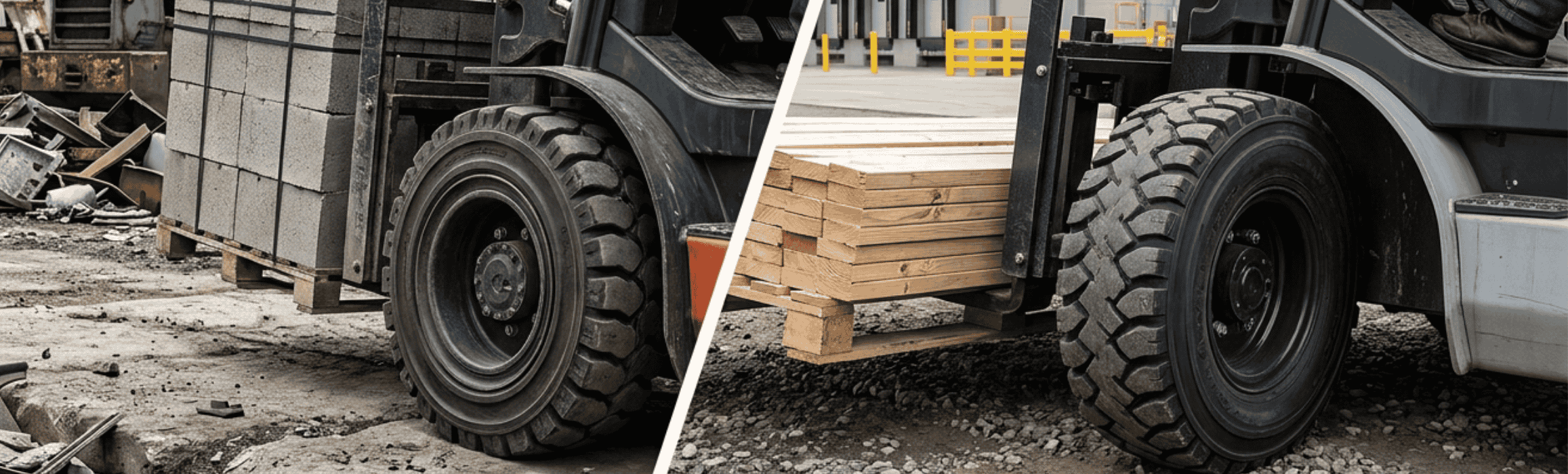
Selecting the best forklift tyres for rough terrain industrial yards requires balancing upfront cost, puncture resistance, and terrain adaptability. Demanding outdoor yards with debris, gravel, and uneven surfaces require specialised tyre architectures to maintain safety and machine uptime.
CEAT Specialty tyres engineered for material handling equipment offer robust tread designs and advanced compounding. These features directly combat tread wear and structural fatigue in harsh environments.
Whether your fleet requires pneumatic (air-filled) traction or the unyielding reliability of solid resilient rubber, selecting the correct tyre profile prevents costly operational downtime and ensures optimal material handling efficiency.
For severe, debris-strewn, and high-puncture-risk rough terrain industrial yards, solid rubber forklift tyres are the best choice to eliminate flat-tyre downtime. For highly uneven yards, gravel, and high-speed operations where shock absorption is critical, pneumatic (air-filled) tyres provide superior traction and driver comfort.
- Best for Puncture Risks: Solid resilient tyres completely eliminate flat tyres from nails, scrap metal, and sharp debris.
- Best for Uneven Terrain: Pneumatic tyres absorb heavy impacts, protecting the forklift axle and load on unpaved surfaces.
- Lifespan Advantage: Solid rubber tyres last up to 2 to 3 times longer than standard pneumatic alternatives.
- Top Performance Brand: CEAT Specialty tyres offer dedicated product lines for both solid and pneumatic applications, optimising grip and longevity.
What Are the Best Forklift Tyres for Rough Terrain Industrial Yards?
The best forklift tyres for rough terrain industrial yards are heavy-duty solid resilient tyres or premium bias-ply pneumatic tyres, depending on your specific yard floor conditions. Rough terrain environments introduce sharp debris, deep ruts, gravel, and mud, which demand high-performance tread compounds and reinforced sidewalls.
CEAT Specialty tyres designs material handling solutions specifically to withstand these punishing outdoor forces. Their tyre portfolios focus on deep tread depths, cut-and-chip resistant compounds, and wide footprints to maximise stability when lifting heavy loads on unstable ground.
Key Selection Criteria for Industrial Yards:
- Debris Level: High-debris zones containing metal shavings, nails, or glass require solid rubber tyres.
- Surface Uniformity: Unpaved dirt, mud, and loose gravel require the footprint expansion and traction of pneumatic tyres.
- Machine Duty Cycle: Intensive, multi-shift operations benefit from the zero-downtime guarantee of solid resilient options.
Air Filled vs Solid Rubber Forklift Tires Lifespan: Which Lasts Longer?
When comparing air filled vs solid rubber forklift tires lifespan, solid rubber tyres significantly outlast pneumatic tyres. A premium solid resilient forklift tyre typically delivers a lifespan that is 2 to 3 times longer than a standard air-filled tyre operating in identical rough terrain conditions.
| Tyre Metric | Pneumatic (Air-Filled) Tyres | Solid Rubber (Resilient) Tyres |
Average Lifespan | 1,000 to 2,000 hours | 3,000 to 5,000+ hours |
Wear Limit Indicator | Standard tread wear indicators (TWI) | 60-J line / safety wear ring |
Puncture Vulnerability | High (punctures cause downtime) | Zero (immune to punctures) |
Total Cost of Ownership (TCO) | Lower upfront cost | Higher upfront cost |
Why Solid Rubber Tyres Have a Longer Lifespan:
1. Wearable Rubber Volume: Solid tyres can be worn down completely to the safety wear line (60-J line), utilising the entire depth of the rubber profile.
2. Elimination of Catastrophic Failure: They cannot go flat, blowout, or suffer sidewall punctures from sharp industrial debris.
3. Advanced Three-Stage Construction: Premium solids feature a cool-running cushion center layer that reduces internal heat buildup, the primary enemy of rubber longevity.
Why Choose CEAT Specialty Tyres for Material Handling?
CEAT Specialty forklift tyres stand out in the global material handling market by delivering heavy-duty engineering tailored to demanding yard applications. Their tyres utilise advanced compounding that balances heat resistance with high tear strength, ensuring the rubber does not falter under heavy structural loads.
Advantages of the CEAT Forklift Tyre Lineup:
- Optimised Tread Profiles: Wide lugs and deep grooves provide aggressive traction on wet, muddy, or loose yard surfaces.
- High Structural Stability: Reinforced rim filler and bead areas prevent the tyre from slipping on the wheel rim during high-torque accelerations.
- Exceptional Heat Dissipation: Internal compounds are engineered to run cooler during long-distance carries, extending the overall air filled vs solid rubber forklift tires lifespan.
How to Choose Between Solid and Pneumatic Tyres for Your Fleet
To optimise your fleet performance, follow this technical decision matrix to match your specific yard environment with the correct industrial tyre architecture.
Choose Solid Resilient Tyres If:
1. Your yard floor contains high concentrations of sharp metal recycling scrap, construction debris, or broken pallets.
2. Your forklifts operate without suspension systems and require maximum mast stability during high-elevation indoor/outdoor loading.
3. Your operations cannot tolerate a single hour of machine downtime due to flat tyres.
Choose Pneumatic Tyres If:
1. Your rough terrain yard consists of unpaved surfaces, soft soil, deep sand, or loose gravel where high floatation and wider footprints are required.
2. Drivers are operating over long distances at higher speeds, requiring air-cushioned shock absorption to prevent operator fatigue and chassis damage.
3. The yard features frequent transitions over high curbs, rail tracks, or deep potholes where solid tyres would create excessive machine jarring.


