ceat-speciality:blogs-tags/all,ceat-speciality:blogs-tags/products
Flotation Tyres Explained: When Standard Tyres Sink and FLOATMAX Keeps You Moving
Mon, 7 Sep 2026 | PRODUCTS


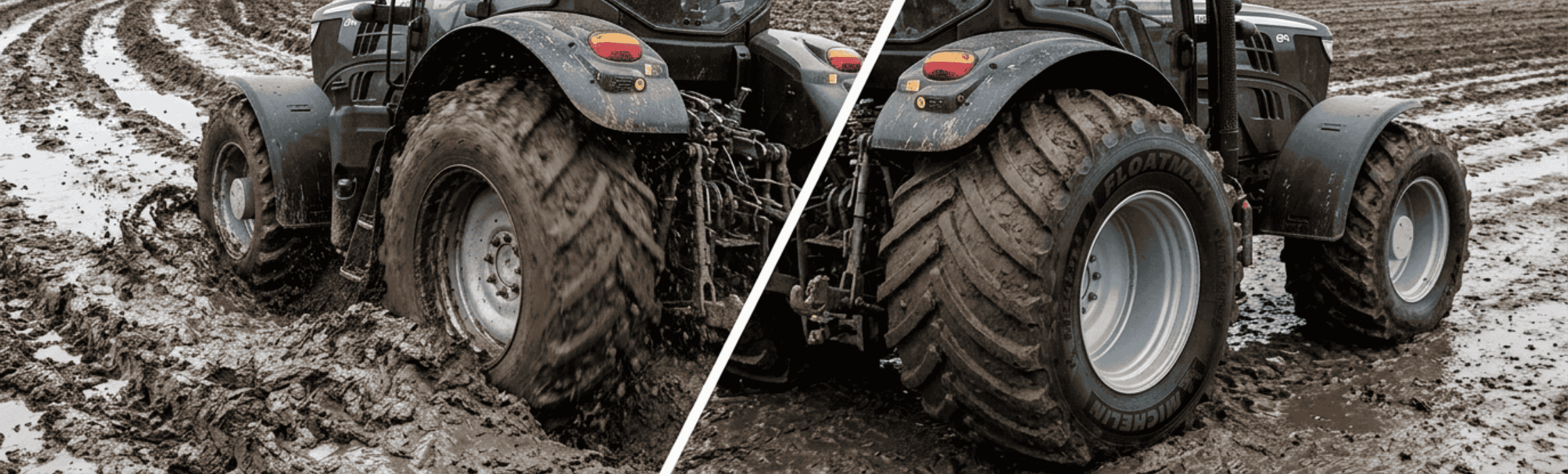
Table of Contents
- About CEAT Specialty Tyres
- Key takeaways for soil compaction management:
- What Is Soil Compaction in Agriculture and Why Is It Harmful?
- How Do Agricultural Tyres Prevent Soil Compaction?
- What Is VF and IF Technology in CEAT Specialty Tyres?
- Premium Solutions: CEAT Specialty Torquemax Tractor Tyre
- Rounding Off: How to Optimise Tyre Usage to Protect Your Soil Step by Step
About CEAT Specialty Tyres
CEAT Specialty tyres houses a team of industry professionals dedicated to publishing accurate, well-researched and practical content on agricultural and OTR tyres. Our editorial team reviews every article for accuracy, clarity and relevance, using trusted sources and current industry best practices.
Standard trailer tyres carry high inflation pressures, causing deep soil rutting, root damage and lost fuel efficiency. Agricultural flotation tyres solve this by distributing heavy equipment loads over a significantly larger footprint, reducing ground pressure and soil compaction.
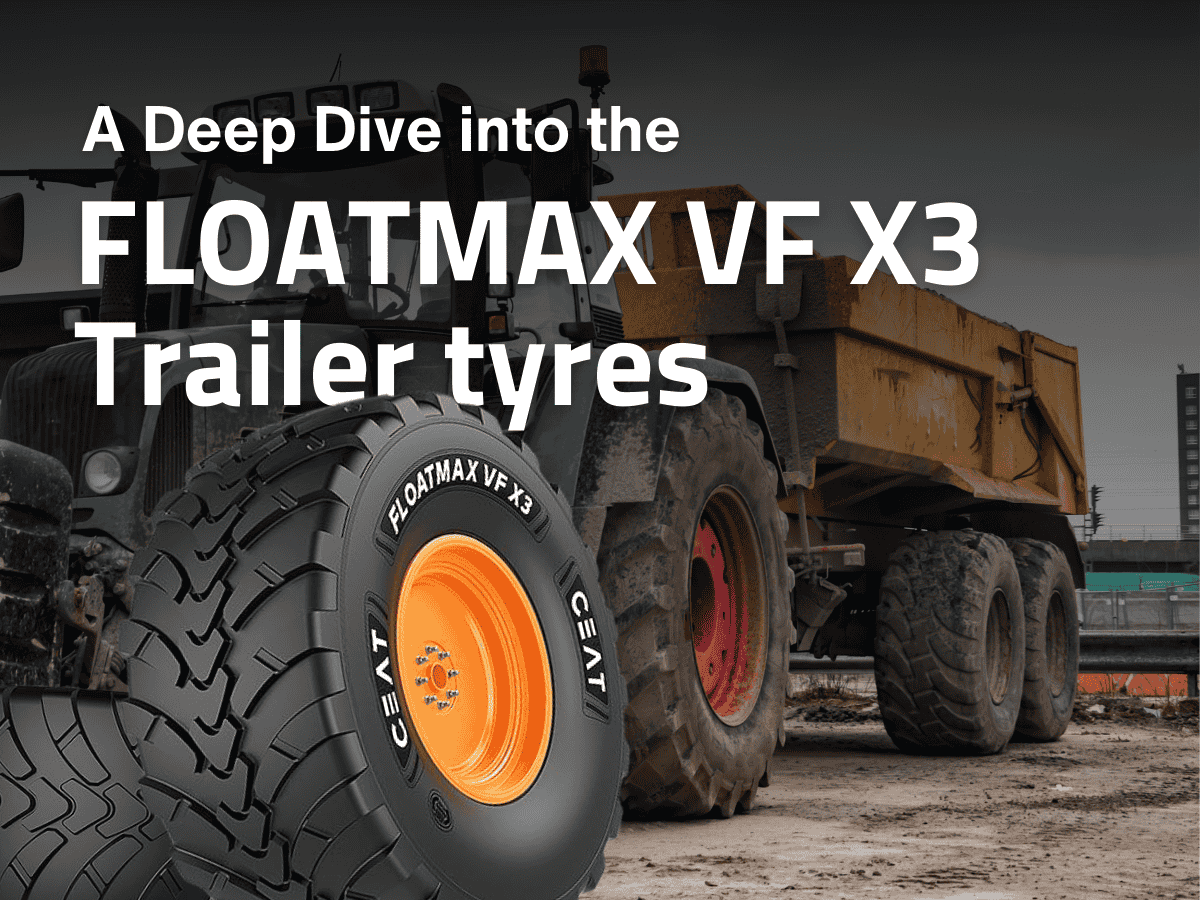
CEAT Specialty tyres engineered the FLOATMAX range, including the FLOATMAX VF X3, FLOATMAX RT and FLOATMAX FT, specifically to protect soil health, improve traction and lower operating costs on modern farms.
Key Takeaways:
- Soil Protection: Flotation tyres distribute heavy axle loads over wider surface areas, minimising ground contact pressure.
- Lower Compaction: Reducing root-zone compaction increases crop yield potential and preserves soil structure.
- Improved Efficiency: Higher traction and reduced rolling resistance lead to lower fuel consumption and faster field operations.
- Versatility: Solutions like CEAT Specialty FLOATMAX VF X3 allow operators to run lower pressures in the field or haul heavy loads at higher road speeds.
What are agricultural flotation tyres?
Agricultural flotation tyres are extra-wide radial tyres designed with flexible sidewalls and optimised tread patterns. They spread machinery weight over a larger footprint, allowing heavy trailers to "float" over soft soil instead of sinking into deep ruts.
Core Benefits of CEAT FLOATMAX Tyres:
- Footprint Expansion: Up to 40–50% wider contact area than standard bias-ply or narrow radial tyres.
- VF Technology (Floatmax VF X3): Carries up to 40% more load at the same inflation pressure, or the same load at 40% lower pressure.
- Tread Durability: Optimised lug design (RT) and block tread pattern (FT) deliver low rolling resistance and high road mileage.
- Soil Yield Defense: Prevents hardpan formation, ensuring better water infiltration and root growth.
How Do Agricultural Flotation Tyres Prevent Soil Compaction?
Flotation trailer tyres prevent soil compaction by spreading the total weight of agricultural machinery over a larger surface area, directly lowering the pressure exerted on the ground. Lower ground pressure prevents topsoil rutting and deep subsoil compaction.
When heavy farm equipment passes over fields on standard narrow tyres, high inflation pressure creates narrow contact patches. This crushes soil pores, limiting oxygen and water movement to plant roots.
Key Strategies to Reduce Soil Compaction:
- Increase Tyre Width: Transition from standard narrow treads to wide flotation profiles.
- Lower Inflation Pressure: Utilise radial and Very High Flexion (VF) construction to run reduced field pressure.
- Increase Air Volume: Larger internal tyre volume supports heavy equipment loads without requiring high inflation pressures.
Standard Tyres vs. FLOATMAX Flotation Tyres: What Is the Difference?
Standard agricultural tyres use narrow profiles and stiffer construction, leading to deeper ruts and higher soil degradation under heavy loads. CEAT Specialty FLOATMAX tyres utilise radial construction, specialised rubber compounds and wide tread profiles to maximise footprint area and tread longevity.
| Feature / Metric | Standard Agricultural Tyres | CEAT Specialty FLOATMAX Tyres |
Contact Footprint | Narrow and long | Extra-wide and uniform |
Soil Rutting Depth | High (Deep trenching in wet soil) | Minimal (Surface-level impression) |
Ground Contact Pressure | High (Crushes soil pore space) | Low (Preserves soil structure) |
Road Traction & Mileage | Standard wear rate | High resistance to tread scrubbing |
Ideal Applications | General row-crop cultivation | Slurry tankers, heavy trailers, spreaders |
Which CEAT FLOATMAX Tyre Is Best for Your Equipment?
Selecting the right CEAT Specialty tyre depends on machinery type, speed requirements, field conditions and road-to-field transport ratios. The brand offers three tailored flotation patterns:
1. CEAT Specialty FLOATMAX VF X3 (Very High Flexion Technology)
- Directional pattern gives high protection against aquaplaning, excellent handling.
- A big center block at the tread center provides more traction.
- VF flotation tyre provides 40% low inflation pressure, improved crop product and efficiency, lower fuel consumption and reduced soil compaction.
Explore CEAT Specialty FLOATMAX VF X3
2. CEAT Specialty FLOATMAX RT (Radial Flotation)
- Delivers larger footprint and lower compaction owing to its flatter crown width.
- The pattern of interconnected grooves is designed for better self cleaning and rounded shoulders ensure less damage to soil and crops.
- Steel belted construction promises puncture and stubble damage resistance making the tyre durable.
Explore CEAT Specialty FLOATMAX RT
3. CEAT Specialty FLOATMAX FT
- Better floating characteristics
- Directional lugs offer superior traction
- Robust centre block provide enhanced stability and roadability
- A wider and flatter crown ensures better floatation
Explore CEAT Specialty FLOATMAX FT
Rounding Off: How to Reduce Soil Compaction Using Flotation Trailer Tyres
Reducing soil compaction requires a combined approach of right tyre selection, accurate pressure adjustments and weight management.
1. Calculate Total Axle Weight: Check maximum fully-laden equipment weights before selecting tyre load indexes.
2. Select Wide Radial Profiles: Replace standard cross-ply or narrow tyres with wide flotation options like CEAT Specialty FLOATMAX trailer tyres.
3. Set Correct Field Pressures: Lower inflation pressure when entering fields to maximise contact footprint.
4. Utilise VF Tyres for Field-to-Road Flexibility: Choose VF tyres to handle both low-pressure field work and high-speed road hauling without constantly manual pressure tweaks.