ceat-speciality:blogs-tags/all,ceat-speciality:blogs-tags/products
How Directional Tread in GM LOADER HD Tyre Improves Skid Steer Performance on Hard Surfaces
Fri, 28 Aug 2026 | PRODUCTS


About CEAT Specialty Tyres
CEAT Specialty tyres houses a team of industry professionals dedicated to publishing accurate, well-researched, and practical content on agricultural and OTR tyres. Our editorial team reviews every article for accuracy, clarity, and relevance, using trusted sources and current industry best practices.
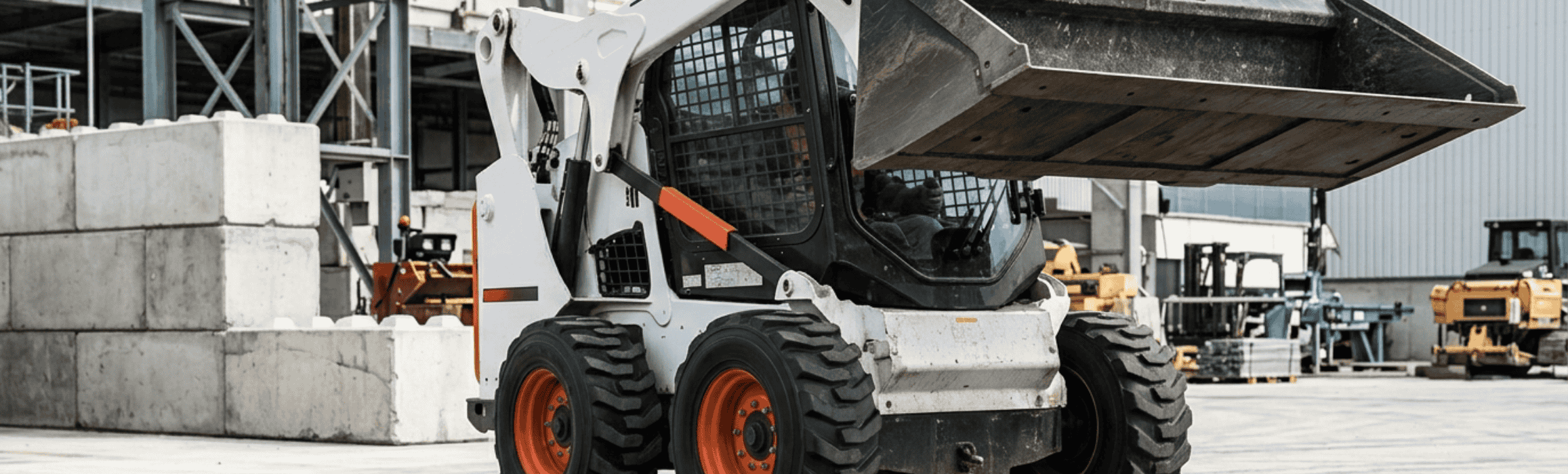
Operating a skid steer on hard, abrasive surfaces like asphalt, concrete and compacted industrial yards requires a specialised tyre built for maximum friction, stability and wear resistance. Standard off-road tyres quickly wear down, lose traction and degrade machine efficiency when subjected to the high-stress scrubbing of hard surface turns.
The CEAT Specialty tyres GM Loader HD is engineered specifically to solve these challenges for industrial operations. By leveraging an optimised directional tread pattern and heavy-duty design elements, this tyre enhances machine handling, lowers operating costs and maximises productivity on rough surfaces.
The directional tread pattern on the GM Loader HD improves skid steer performance on hard surfaces by maximising the contact patch, optimising forward traction and minimising tread squirm during zero-turn maneuvers. This design ensures uniform wear distribution across asphalt and concrete, preventing premature lug breakdown.
- Enhanced Hard-Surface Traction: Siped directional lugs grip smooth and abrasive surfaces efficiently.
- Superior Machine Stability: A dedicated center tie bar stops lateral lug flexing.
- Extreme Puncture Resistance: Extra-thick sidewalls protect against cuts, chips and rim damage.
- Industrial-Grade Construction: Deep tread depth and heavy-ply ratings handle massive vertical loads.
Why Is Directional Tread Important for Skid Steers on Asphalt?
Directional tread geometry aligns the tyre lugs in a specific V-shape configuration to optimise the force distribution between the machine and the pavement. When searching for the best skid steer tyres for asphalt, operators must prioritise tread stability because pavement exerts massive shearing forces on the rubber compound during counter-rotation.
- Uniform Footprint Pressure: The directional layout ensures that load weight transitions smoothly from lug to lug, minimising localised heat build-up.
- Reduced Tread Scrubbing: It reduces the destructive scrubbing action that occurs when skid steers pivot on hard, unforgiving surfaces.
- Consistent Braking and Forward Force: The angled lugs lock onto smooth surfaces to prevent slipping under heavy bucket loads.
How the Center Tie Bar Enhances Skid Steer Stability
Hard-surface applications place severe lateral stress on tyre lugs. The CEAT Specialty GM Loader HD integrates a robust structural tie bar right at the center of the tread pattern to stabilise the individual lugs under heavy operational weight.
Without a center tie bar, individual lugs bend and flex during high-torque operations, leading to uneven heel-and-toe wear. By binding the center section together, the GM Loader HD ensures a rigid center spine. This delivers precise steering response, a smoother ride for the operator and highly predictable tracking when pushing or scraping asphalt.
Maximising Durability with Extra Sidewall Protection
Industrial jobsites expose wheels to constant impact hazards from curbs, debris and structural steel. The GM Loader HD is designed with an extra-thick sidewall and specialised rim guards to counter these environmental risks.
| Feature | Engineering Attribute | Operational Benefit |
Thick Sidewall Rubber | Enhanced Cut & Chip Resistance | Prevents punctures from sharp masonry and debris |
Nylon Casing | High-Tensile Structural Ply | Absorbs heavy impacts without structural carcass failure |
Rim Guard Deflector | Dedicated Deflection Ridge | Protects the wheel rim flange area from damage and air leaks |
This extra sidewall protection guarantees that the tyre remains functional even when subjected to intense scrubbing alongside concrete barriers and aggregate piles.
Final Thoughts: The Role of Higher Construction in Industrial Applications
The term "higher construction" indicates that the tyre is manufactured with premium tread depth, robust compound volume and a high ply rating (up to 14 PR). This structural upgrade makes CEAT Specialty tyres uniquely qualified for heavy-duty industrial environments.
1. Increased Load Capacity: The heavy-ply bias construction safely manages the extreme front-axle loads generated when the skid steer bucket is fully loaded.
2. Extended Service Life: A deeper usable rubber volume means the tyre can endure thousands of operational hours on abrasive surfaces before requiring replacement.
3. Puncture Deflection: The dense carcass and deep tread prevent sharp industrial objects from penetrating the internal air chamber.