ceat-speciality:blogs-tags/all,ceat-speciality:blogs-tags/products
VF vs Standard Trailer Tyres: Which Improves Farm Efficiency More?
Fri, 14 Aug 2026 | PRODUCTS



Table of Contents
- About CEAT Specialty Tyres
- Key takeaways:
- What Is the Difference Between VF and Standard Trailer Tyres?
- Does VF Technology Actually Reduce Soil Compaction?
- Which Tyre Type Improves Load Capacity and Payload Efficiency?
- Which Option Is More Fuel-Efficient for Farm Trailers?
- Final Thoughts: Which CEAT Specialty Trailer Tyres Use VF Technology?
About CEAT Specialty Tyres
CEAT Specialty tyres houses a team of industry professionals dedicated to publishing accurate, well-researched, and practical content on agricultural and OTR tyres. Our editorial team reviews every article for accuracy, clarity, and relevance, using trusted sources and current industry best practices.
VF (Very High Flexion) trailer tyres improve farm efficiency more than standard trailer tyres in most field conditions. They carry the same load at up to 40% lower inflation pressure, which reduces soil compaction, improves traction, and lowers fuel consumption during heavy transport work.
Standard trailer tyres still suit lighter loads, road-heavy transport, and lower-budget operations, since standard tarmac trailer tyres typically cost far less than VF or flotation equivalents.
This guide compares VF agricultural trailer tyres against standard construction, covering load capacity, compaction, cost, and total operating efficiency, using CEAT Specialty's trailer tyre range as a technical reference.
VF trailer tyres improve farm efficiency more than standard tyres because they run at up to 40% lower inflation pressure while carrying the same load, which reduces soil compaction, improves fuel economy, and extends tyre life under heavy field use.
Key takeaways:
- CEAT's Floatmax VF X3 runs at up to 40% lower inflation pressure than a standard equivalent tyre carrying the same load.
- Lower inflation pressure means a larger footprint, less soil compaction, and better traction on wet or soft ground.
- Standard tyres remain a valid, lower-cost option for road-based or lighter-load trailer use.
- CEAT Specialty offers VF trailer tyres like Floatmax VF X3 alongside a wider flotation range like Floatmax FT for different load and budget needs.
What Is the Difference Between VF and Standard Trailer Tyres?
VF stands for "Very High Flexion." A VF trailer tyre uses a reinforced casing that flexes more under load, letting it run at significantly lower air pressure than a standard tyre while carrying the same weight.
| Feature | Standard Trailer Tyre | VF Trailer Tyre |
Operating pressure at same load | Higher, fixed range | Up to 40% lower |
Footprint | Smaller | Larger |
Soil compaction | Higher | Reduced |
Best use case | Road haulage, lighter loads | Heavy loads, soft/wet field conditions |
Construction | Radial or bias | Radial (flexion technology) |
Both standard and flotation trailer tyres from CEAT Specialty are available in radial and bias construction; VF is a specific engineering feature applied within CEAT Specialty radial trailer range.
Does VF Technology Actually Reduce Soil Compaction?
Yes. Lower inflation pressure spreads the trailer's weight across a larger tyre footprint, which lowers ground pressure and reduces soil compaction.
Soil compaction restricts root growth, water infiltration, and nutrient uptake, which can reduce yield in later seasons. CEAT Specialty positions its VF tyres as a way to cut soil compaction while maintaining load capacity, supporting soil health and crop output.
How the pressure-compaction link works:
1. Lower psi allows the tyre to deflect more under load.
2. Deflection increases the contact patch on the ground.
3. A larger footprint spreads the same load over more surface area.
4. Ground pressure per square inch drops, reducing compaction depth.
Standard trailer tyres run at higher fixed pressures, concentrate the same load into a smaller footprint, increasing compaction risk on wet or heavy soils during harvest.
Which Tyre Type Improves Load Capacity and Payload Efficiency?
VF trailer tyres improve payload efficiency because they support the same load at meaningfully lower pressure, without needing a larger tyre or extra axle to compensate.
- CEAT Specialty Floatmax VF X3 is built to run at up to 40% lower pressure for the same load compared with a standard equivalent.
- Lower pressure at equal load reduces stress on the tyre casing and spreads weight more evenly across the field surface.
- This can reduce rutting and repeated-pass compaction during heavy grain, slurry, or bale transport.
Standard tyres require higher pressure to reach the same load index, which increases stiffness and raises the risk of soil disturbance on soft ground.
Which Option Is More Fuel-Efficient for Farm Trailers?
VF trailer tyres are generally more fuel-efficient in field conditions because a larger footprint improves traction and reduces wheel slip on soft or uneven ground.
- Less wheel slip directly reduces fuel burn per hectare during field transport.
- CEAT Specialty tyres associate VF flotation technology with lower fuel consumption alongside reduced compaction, as stated on its Floatmax VF X3 product page.
- On hard, flat road surfaces, the fuel-efficiency gap narrows; standard tyres perform adequately for pure road haulage.
VF tyres have an edge for mixed field/road use; standard tyres are comparable for road-only transport.
Final Thoughts: Which CEAT Specialty Trailer Tyres Use VF Technology?
CEAT Specialty's trailer range includes a dedicated VF tyre:
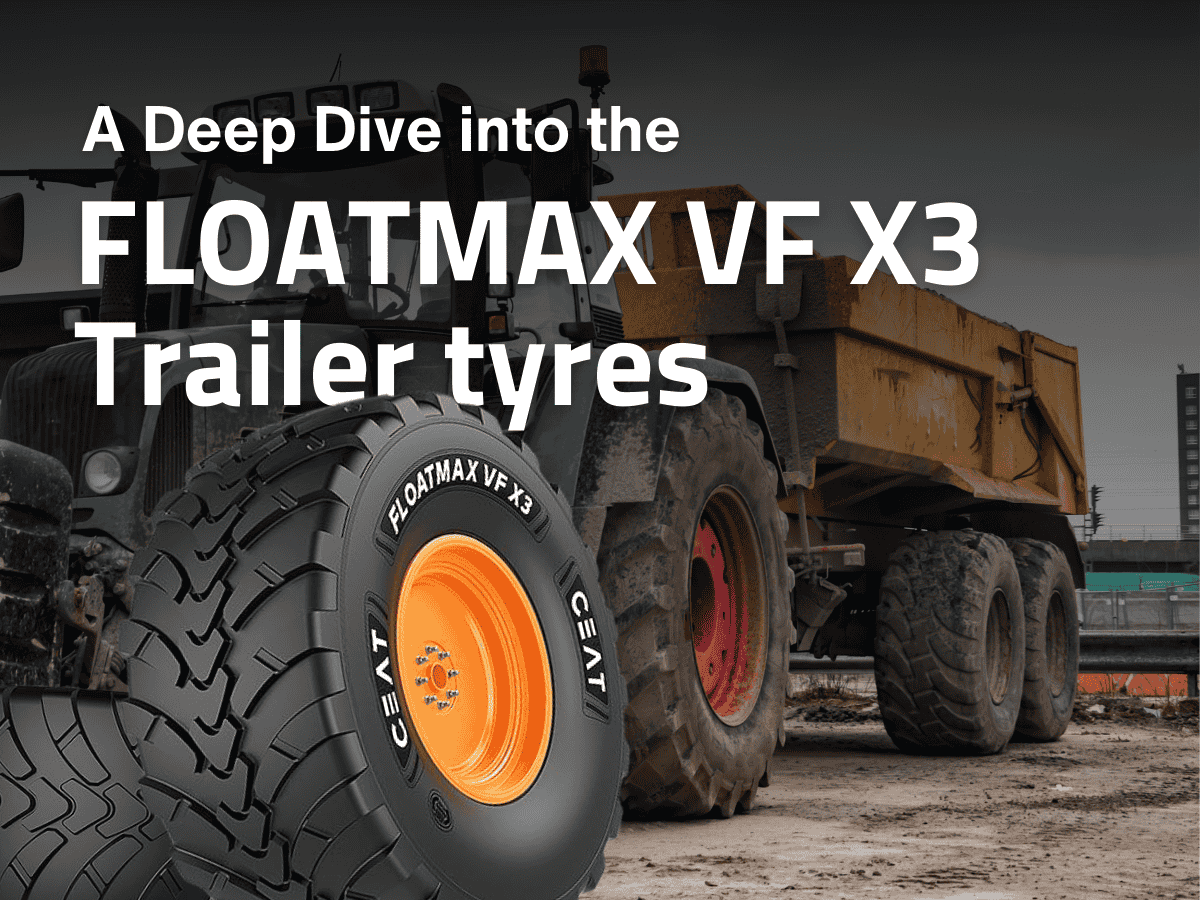
- Floatmax VF X3 — Runs at up to 40% lower inflation pressure than a standard equivalent at the same load, with a directional tread for aquaplaning protection and a reinforced center block for traction.
Features of Floatmax VF X3 Trailer Tyres:
- Directional pattern gives high protection against aquaplaning, excellent handling.
- A big center block at the tread center provides more traction.
- VF flotation tyre provides 40% low inflation pressure, improved crop product and efficiency, lower fuel consumption, and reduced soil compaction.
Operators and dealers should confirm current size availability and pricing directly via the CEAT Specialty trailer tyres page, since range availability varies by region.